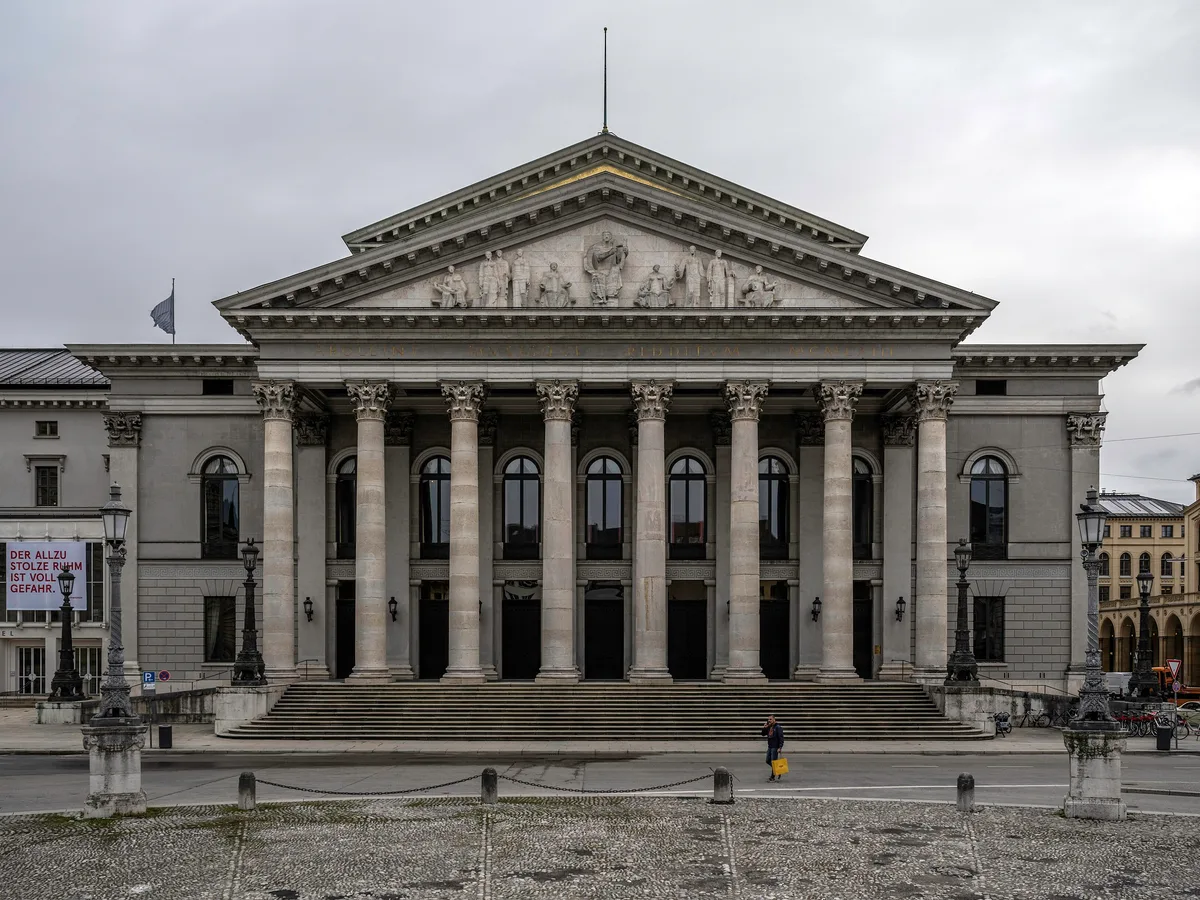
The Bayerische Staatsoper, housed in the Nationaltheater on Munich's Max-Joseph-Platz, is among the most prestigious opera houses in the world. Founded in 1653 as the Bavarian court opera, the company moved into its current home in 1818; the neoclassical building by Karl von Fischer was destroyed during the Second World War and reconstructed faithfully by 1963. The house has been the site of defining premieres—including Wagner's Tristan und Isolde (1865) and Die Meistersinger von Nürnberg (1868)—and maintains a repertoire combining core Wagner, Strauss, and Mozart with major new productions. The company operates the 2,100-seat Nationaltheater alongside the intimate Cuvilliés-Theater and the modern Prinzregententheater. Under successive general music directors—Wolfgang Sawallisch, Zubin Mehta, Kent Nagano, Kirill Petrenko, Vladimir Jurowski—the Bayerische Staatsoper has remained a touchstone of international operatic performance. The annual Munich Opera Festival in July draws audiences from around the world for concentrated programming of the house's signature productions.
The Nationaltheater has been built three times: opened in 1818, it burned down in 1823, was rebuilt, then destroyed in the Second World War. The third version opened in 1963.
At a glance
- Type
- Opera house
- Location
- Munich, Germany
More venues in Munich
- Gasteig HP8 · Concert hall, Munich
- Isarphilharmonie · Concert hall, Munich
- Komödie im Bayerischen Hof · Theatre, Munich
- Münchner Kammerspiele · Theatre, Munich
- Prinzregententheater · Opera house, Munich
- Residenztheater München · Theatre, Munich
- Staatstheater am Gärtnerplatz · Multi-genre theatre, Munich
More venues in Germany
- Aalto-Theater · Opera house, Essen
- Admiralspalast · Musical theatre, Berlin
- Alte Oper Frankfurt · Concert hall, Frankfurt am Main