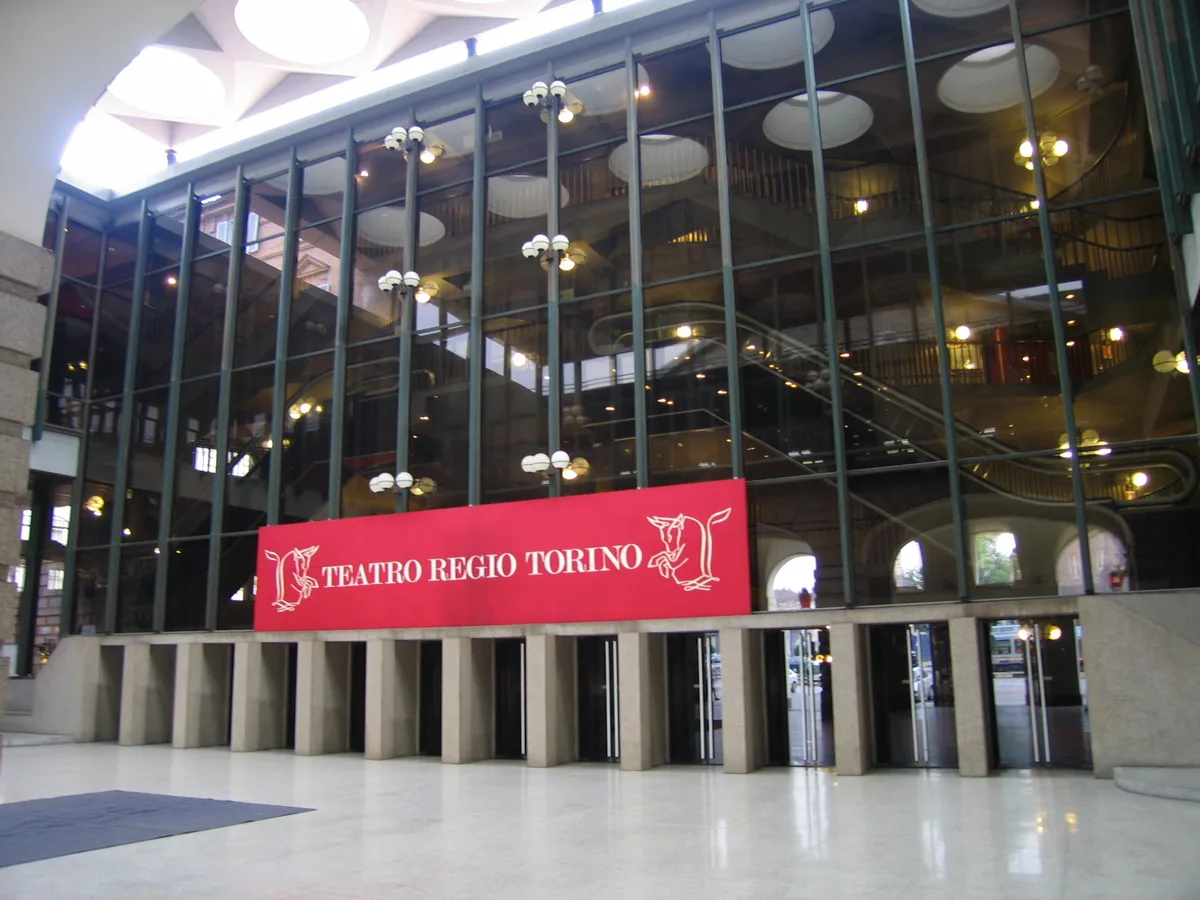
The Teatro Regio di Torino on Piazza Castello opened on 26 December 1740 with Francesco Feo's Arsace. It was first planned by Filippo Juvarra and built after his death under Benedetto Alfieri. Puccini's Manon Lescaut (1893) and La Bohème (1896) had their premieres here, and Arturo Toscanini was conductor of the Turin Opera from 1895 to 1898. In February 1936 a fire destroyed everything but the façade, and the house stayed closed for 37 years. Reconstruction to designs by Carlo Mollino only began in 1967; on 10 April 1973 it reopened with Verdi's I vespri siciliani, directed by Maria Callas and Giuseppe Di Stefano. Since then a modern elliptical auditorium has stood behind the historic façade. The arcaded façade has been part of the UNESCO World Heritage Site of the Residences of the Royal House of Savoy since 1997.
The Teatro Regio di Torino, founded in 1740, burned down in 1936 and was rebuilt in 1973 as a modern opera building — the unconventional structure in Italian post-war modernist style is one of the most unusual opera houses in Europe.
At a glance
- Type
- Opera house
- Location
- Turin, Italy
More venues in Italy
- Arena di Verona · Opera house, Verona
- Artisti in Piazza · Multi-genre theatre, Pennabilli
- Gran Teatro all'Aperto Giacomo Puccini · Opera house, Torre del Lago
- Piccolo Teatro di Milano · Theatre, Milan
- Sferisterio di Macerata · Opera house, Macerata
- Teatro Alighieri · Opera house, Ravenna
- Teatro alla Scala · Opera house, Milan
- Teatro Amilcare Ponchielli · Opera house, Cremona
- Teatro Carlo Felice · Opera house, Genua
- Teatro Coccia · Opera house, Novara