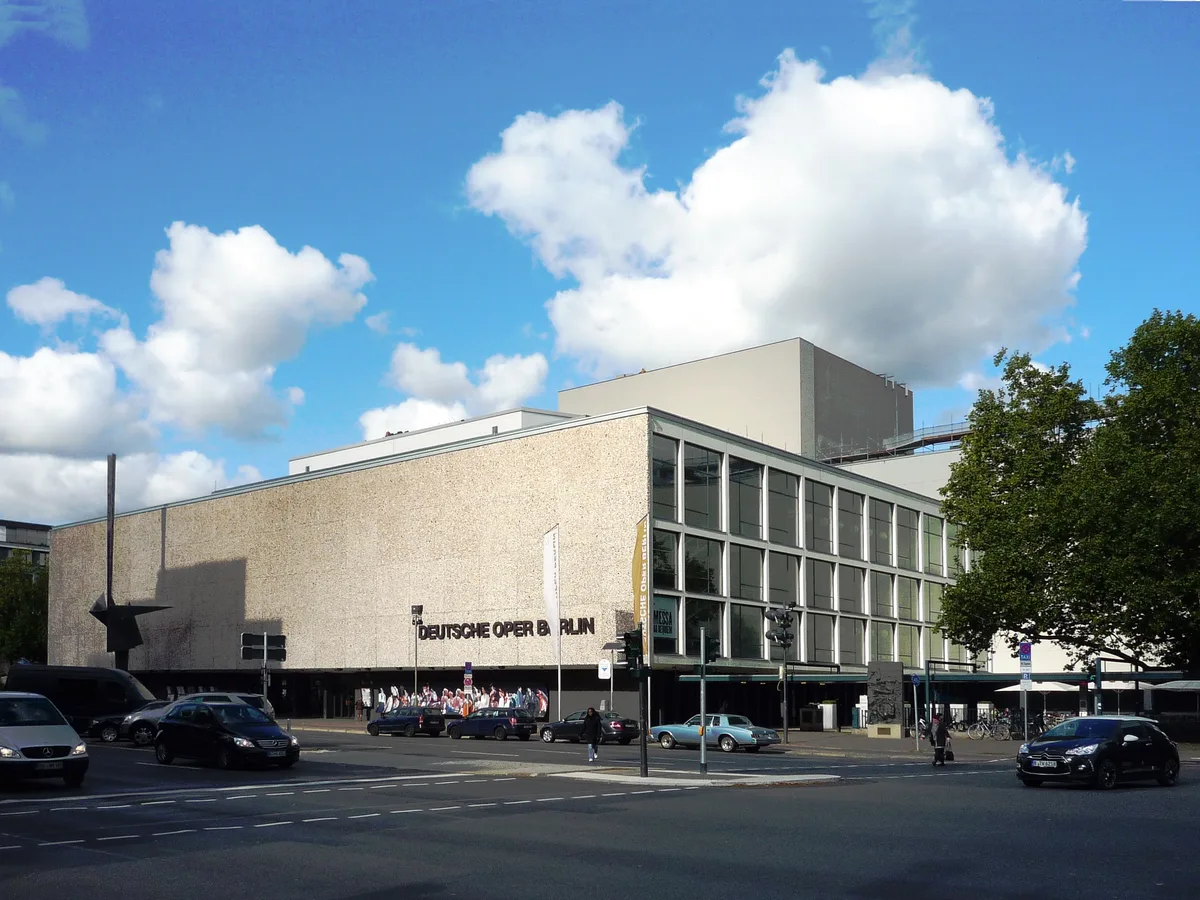
The Deutsche Oper Berlin is the largest opera house in the German capital, with 1,865 seats. Founded in 1912 as the Deutsches Opernhaus to provide a middle-class alternative to the court opera Unter den Linden, the company moved after the Second World War to its current location on the Bismarckstraße in former West Berlin. The present building by Fritz Bornemann, completed in 1961, is a landmark of postwar German modernist architecture, its severe concrete façade concealing a warm and acoustically renowned auditorium. During the division of Berlin, the Deutsche Oper emerged as the opera house of the Western city and welcomed important guest conductors including Lorin Maazel, Jesús López Cobos, and Christian Thielemann. Götz Friedrich's long tenure as Intendant (1981-2000) produced legendary Wagner stagings, among them the Ring Cycle in the bunker concept. The house continues to combine a broad international repertoire with bold productions from directors such as Tobias Kratzer, David Alden, and Jossi Wieler.
Götz Friedrich's legendary 1984 Ring cycle took place inside a radioactive bunker—his concept for the work in the shadow of nuclear anxiety. The production ran for twenty-five years.
At a glance
- Type
- Opera house
- Location
- Berlin, Germany
More venues in Berlin
- Admiralspalast · Musical theatre, Berlin
- Ballhaus Naunynstraße · Theatre, Berlin
- Bar jeder Vernunft · Theatre, Berlin
- Berliner Ensemble · Theatre, Berlin
- Deutsches Theater Berlin · Theatre, Berlin
- Die Distel · Theatre, Berlin
- Die Wühlmäuse · Theatre, Berlin
- Friedrichstadt-Palast · Musical theatre, Berlin
- Grips-Theater · Theatre, Berlin
- Haus der Berliner Festspiele · Multi-genre theatre, Berlin