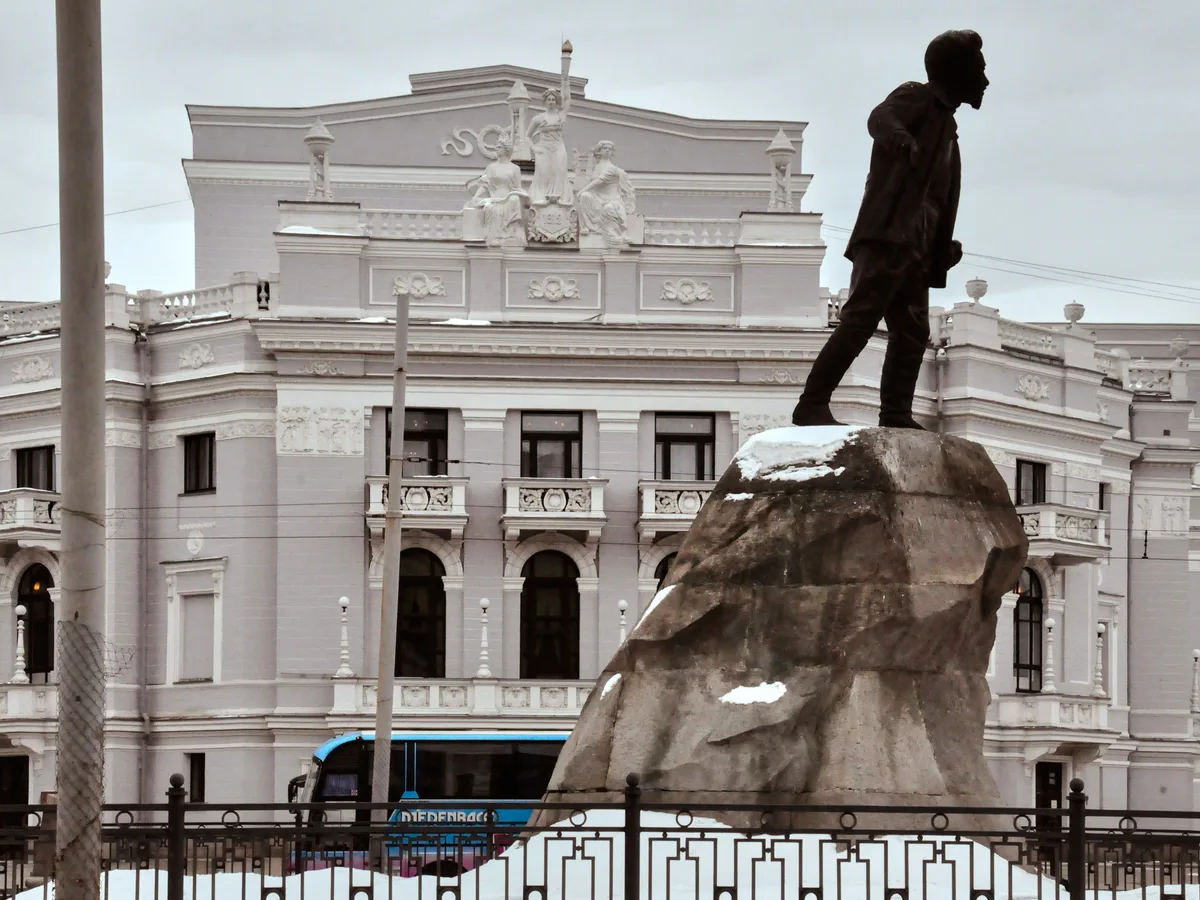
The Yekaterinburg Opera House, today also known as Ural Opera Ballet, was founded in 1912. The competition for the building was won by the St Petersburg civil engineer Vladimir Semyonov with his design "Svetlana". After the foundation stone was laid in 1910, a house with a horseshoe-shaped auditorium for 1,200 spectators, rich stucco work and a group of three Muses on the attic rose on the main avenue. It opened on 12 October 1912 with Glinka's A Life for the Tsar. In 1917 Soviet power in the city and the Urals was proclaimed here. In 1946 it became the first provincial theatre to win the Stalin Prize, for Verdi's Otello, and in 1987 it won a State Prize for the premiere of Vladimir Kobekin's The Prophet. It has been an academic theatre since 1966 and has won 26 Golden Mask awards.
The Yekaterinburg Opera House, opened in 1912 in Art Nouveau style, is one of the most significant opera houses in the Urals — the city in eastern Russia was a cultural centre of the mining region in the nineteenth century.
At a glance
- Type
- Opera house
- Location
- Jekaterinburg, Russia
More venues in Russia
- Bolschoi-Theater · Opera house, Moscow
- Mariinski-Theater · Opera house, Sankt Petersburg
- Michailowski-Theater · Opera house, Sankt Petersburg
- Nowaja Opera · Opera house, Moscow
- Opernhaus Kasan · Opera house, Kasan
- Opernhaus Nowosibirsk · Opera house, Nowosibirsk
- Opernhaus Perm · Opera house, Perm
- Opernhaus Samara · Opera house, Samara