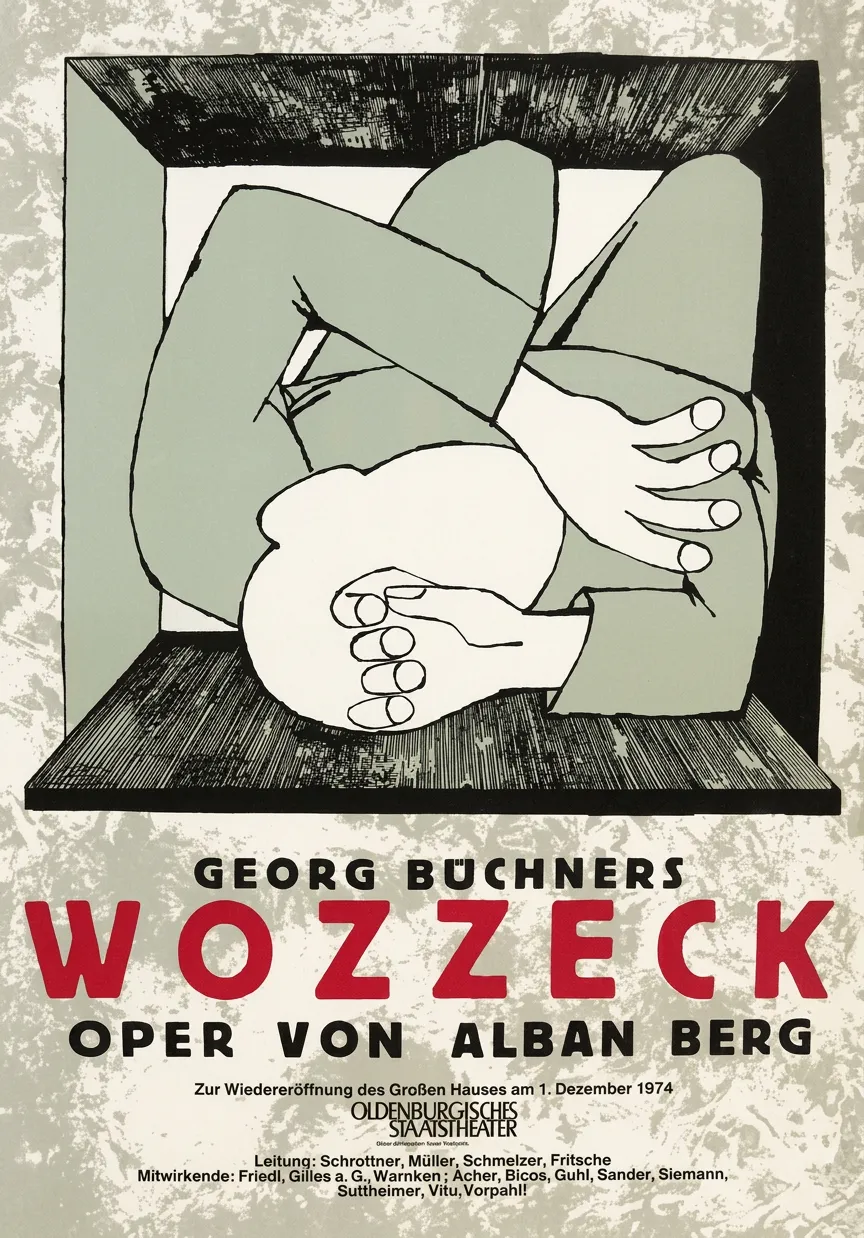
About the work
Alban Berg's three-act atonal opera, based on Georg Büchner's fragmentary play Woyzeck, was premiered in 1925 at the Staatsoper Unter den Linden in Berlin under Erich Kleiber. Composed between 1914 and 1922, partly during Berg's service in the First World War, the work is the defining opera of the Second Viennese School and one of the supreme masterpieces of twentieth-century music theatre.
Plot
The impoverished soldier Wozzeck eke out a living by performing as test subject for a sadistic Doctor who feeds him only beans to study the effects. His superior, the Captain, mocks him. Wozzeck's mistress Marie, mother of his illegitimate child, takes up with the swaggering Drum Major. Humiliated and driven mad by voices, Wozzeck lures Marie to a pond and cuts her throat. Later, returning to retrieve the knife, Wozzeck wades into the pond and drowns. The opera ends with their young son playing alone, unaware that he has become an orphan.
Cultural significance
Wozzeck transformed the possibilities of operatic storytelling. Berg developed the work from fifteen of Büchner's fragments, organising each scene around a different classical form—passacaglia, invention, rhapsody—while the music shifts fluidly between atonality and tonal reference. The character of Wozzeck is among the most sympathetic portraits of social victimhood in any opera. The work's influence extends from Britten's Peter Grimes to Shostakovich's Lady Macbeth of Mtsensk and remains the central twentieth-century opera in the international repertoire.