About the work
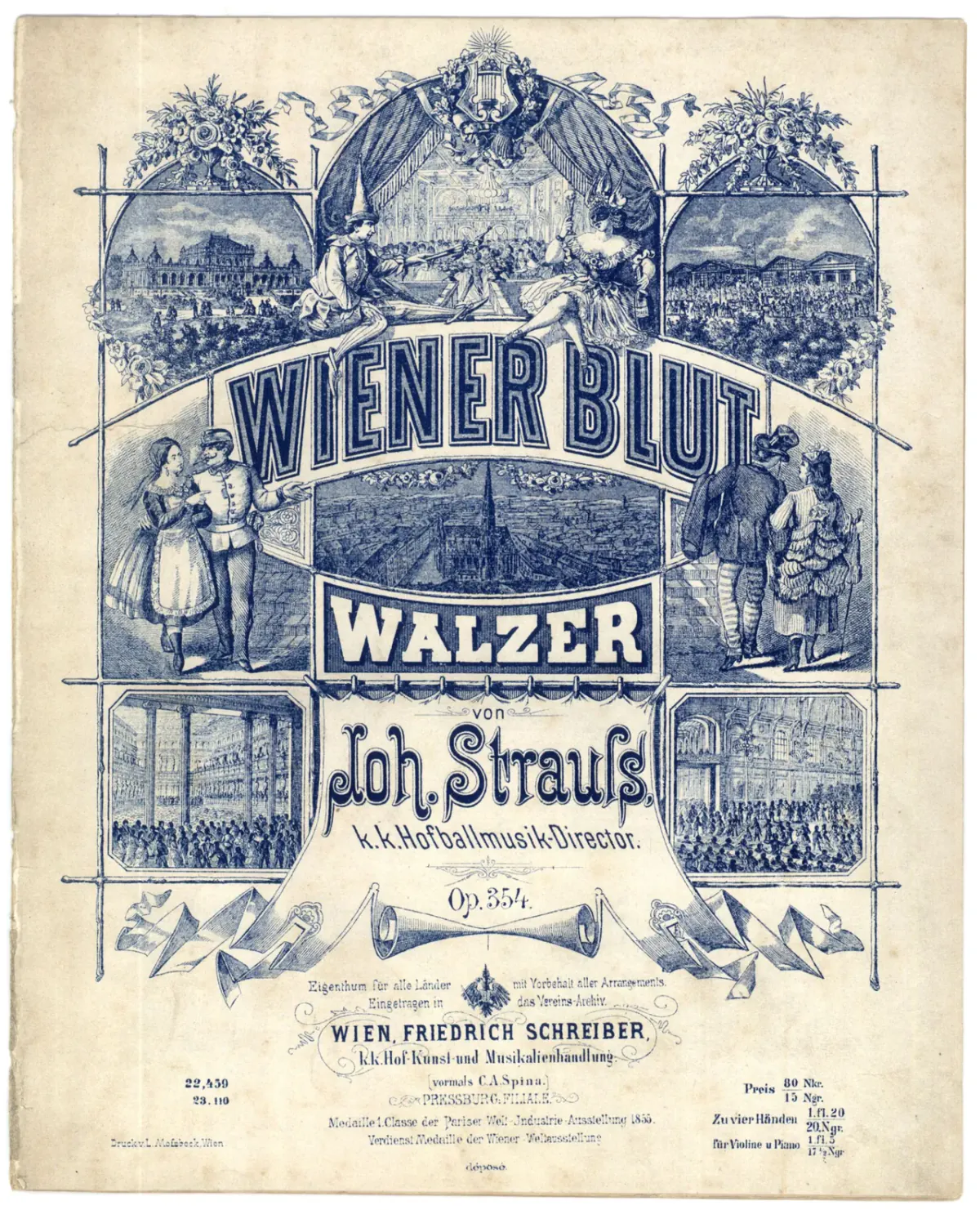
Wiener Blut is a "comic operetta" in three acts by Johann Strauss (son), compiled and arranged by Adolf Müller junior. The title was taken from the concert waltz Wiener Blut, Op. 354 (1873). The operetta premiered on 26 October 1899 at the Carltheater in Vienna. The libretto is by Victor Léon and Leo Stein, who later also wrote the libretto for Franz Lehár's operetta Die lustige Witwe (The Merry Widow).
Plot
The fun-loving Viennese Gabriele has been married to Balduin, Count Zedlau, an envoy of Reuß-Schleiz-Greiz. Before long Zedlau proves thoroughly stuffy, and as he lacks "Viennese blood", Gabriele moves back to her parents' castle. The lonely Zedlau thereupon begins an affair with the beautiful Franziska Cagliari. Balduin also casts an eye on Pepi Pleininger, the girlfriend of his servant Josef, who works as a fitting model. Gabriele learns of her husband's doings and returns to his villa. After turbulent mix-ups, everyone meets at a Heuriger in Hietzing. Gabriele is escorted by Prince Ypsheim-Gindelbach, prime minister of Reuß-Schleiz-Greiz and Count Balduin's superior. Balduin amuses himself with the fitting model Pepi Pleininger, while Josef arrives with the beautiful Franziska Cagliari. Despite everything there is a happy ending: the respective couples (Gabriele and Balduin, Pepi and Josef, Cagliari and Ypsheim-Gindelbach) are reunited, all agreeing that only the Viennese blood can be to blame, and they sing a grand closing chorus.
Cultural significance
The rock singer Falco named his fifth album and its title song after the operetta in 1988; the German band Rammstein did likewise with the eighth track of the album "Liebe ist für alle da": it too is called "Wiener Blut", but uses the title as a cynical metaphor for the Josef Fritzl case. The Slovenian industrial band Laibach adapted the Wiener Blut waltz in 1987 for the stage music to the avant-garde theatre piece "Krst pod Triglavom" ("Baptism under Triglav") by the Neue Slowenische Kunst theatre group "Rdeči Pilot" ("The Red Pilot"), which dealt with the history of Slovenia, including its former belonging to Austria.