About the work
Giuseppe Verdi's three-act opera was premiered on 17 February 1859 at the Teatro Apollo Rome after extensive censorship battles that forced Verdi to relocate the action from real historical Sweden (the assassination of King Gustav III of Sweden in 1792) to fictional colonial Boston. The libretto by Antonio Somma is based on Eugène Scribe's text for Auber's opera Gustave III. Modern productions frequently restore the Swedish setting.
Plot
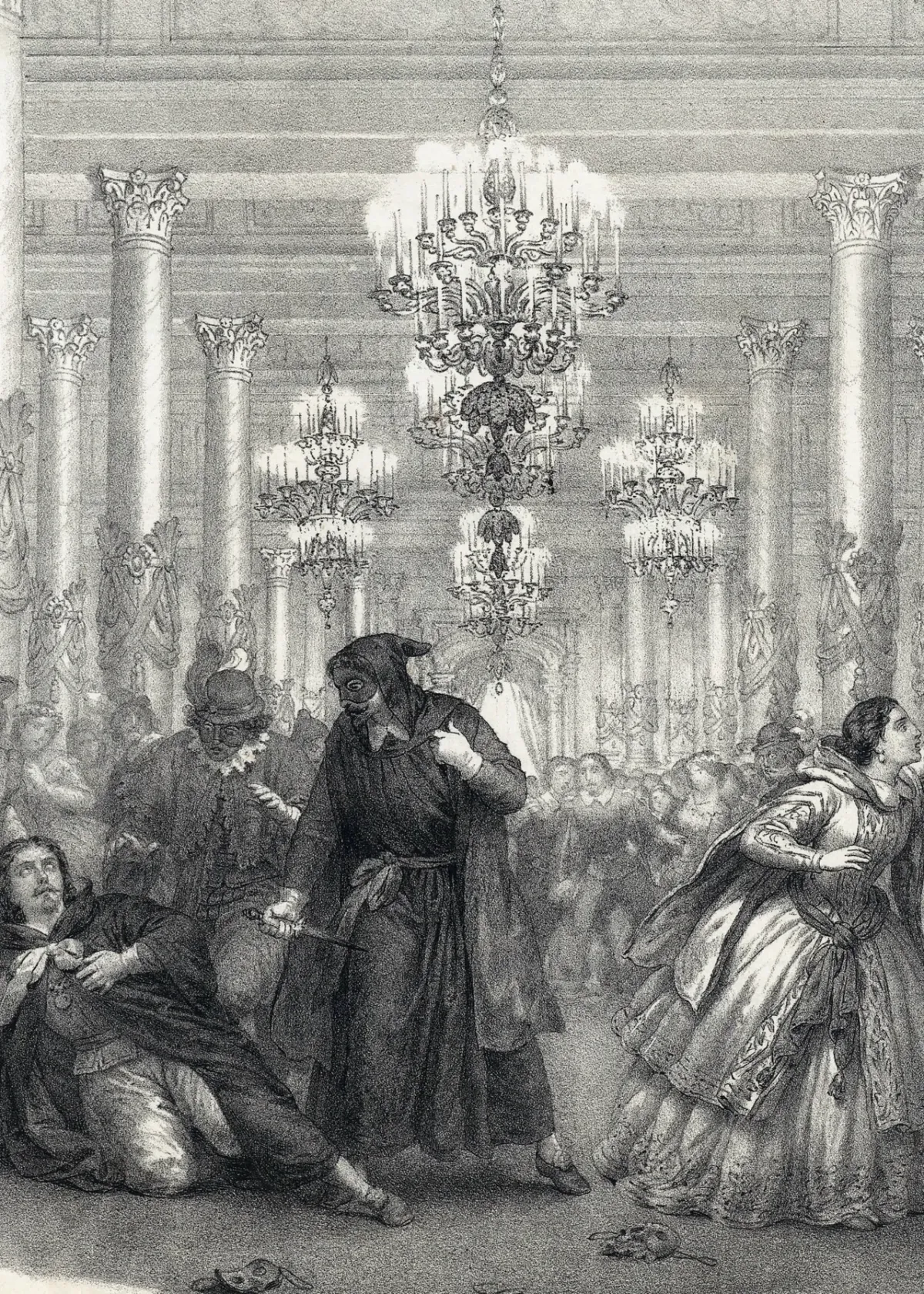
Riccardo, Governor of colonial Boston (originally King Gustav III), is warned by the fortune-teller Ulrica that he will die at the hand of his closest friend. The friend is Renato, husband of Amelia—with whom Riccardo is secretly in love. When Renato finds Amelia and Riccardo together at midnight in the gallows grounds, he assumes adultery. Joining a conspiracy of other noblemen who hate Riccardo for political reasons, Renato volunteers to carry out the assassination. At a masked ball, Renato stabs Riccardo, who forgives him with his dying breath and reveals that Amelia was never unfaithful. Riccardo had already signed orders sending the couple back to Europe to keep them apart.
Cultural significance
Un Ballo in Maschera is one of Verdi's most sophisticated and theatrically elegant operas, combining comic dialogue with tragic intrigue in a single musical fabric. The role of Riccardo requires a lyric tenor capable of stylistic subtlety—Luciano Pavarotti considered it among his most nuanced roles. Renato's aria Eri tu is a baritone centerpiece; Amelia's Morrò, ma prima in grazia is one of the great dramatic soprano arias. The opera's strange oscillation between tragedy and wit, and its explicit focus on political assassination, remain resonant themes.