About the work
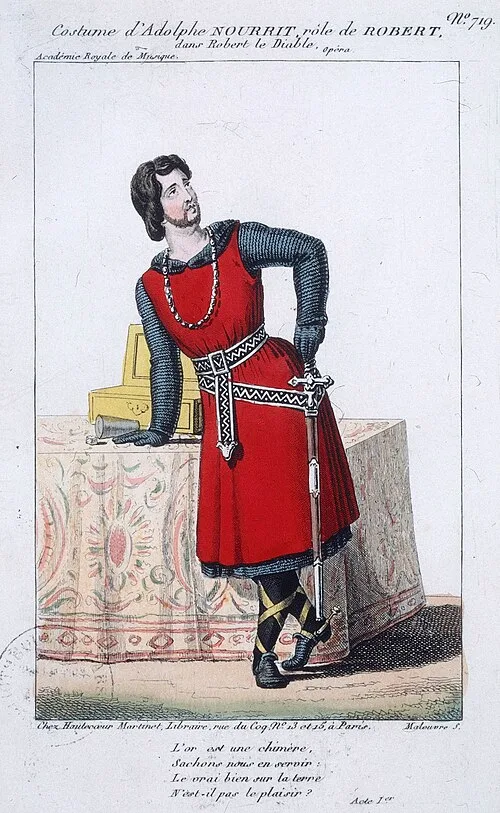
Robert le Diable (Robert the Devil) is an opera in five acts by Giacomo Meyerbeer, premiered on 21 November 1831 at the Paris Opéra. The libretto by Eugène Scribe and Germain Delavigne is loosely based on the medieval legend of the Norman duke Robert. The work is regarded as one of the founding works of French grand opéra.
Plot
Robert, Duke of Normandy, is the son of a mortal and a devil. In exile in Sicily he falls in love with the king's daughter Isabelle. His father, disguised as the mysterious Bertram, tries to win Robert's soul for hell. A chain of misfortunes pursues Robert; in the famous Ballet of the Nuns in a ruined monastery graveyard he is to break a branch from the grave of Saint Rosalie to regain his power. In the end good and evil — the love of Isabelle and the faithful Alice on one side, the devilish Bertram on the other — wrestle for Robert's soul, which is finally saved.
Cultural significance
Robert le Diable was an unprecedented triumph at its premiere and established Meyerbeer's European fame. Chopin, who was in the audience, called it a masterpiece of splendour never seen before. With its spectacular stage effects, dramatic orchestral writing and the iconic Ballet of the Nuns, the work became the model of grand opéra and influenced composers as far as Verdi and Wagner. By 1893 it had been performed more than 750 times at the Paris Opéra alone.