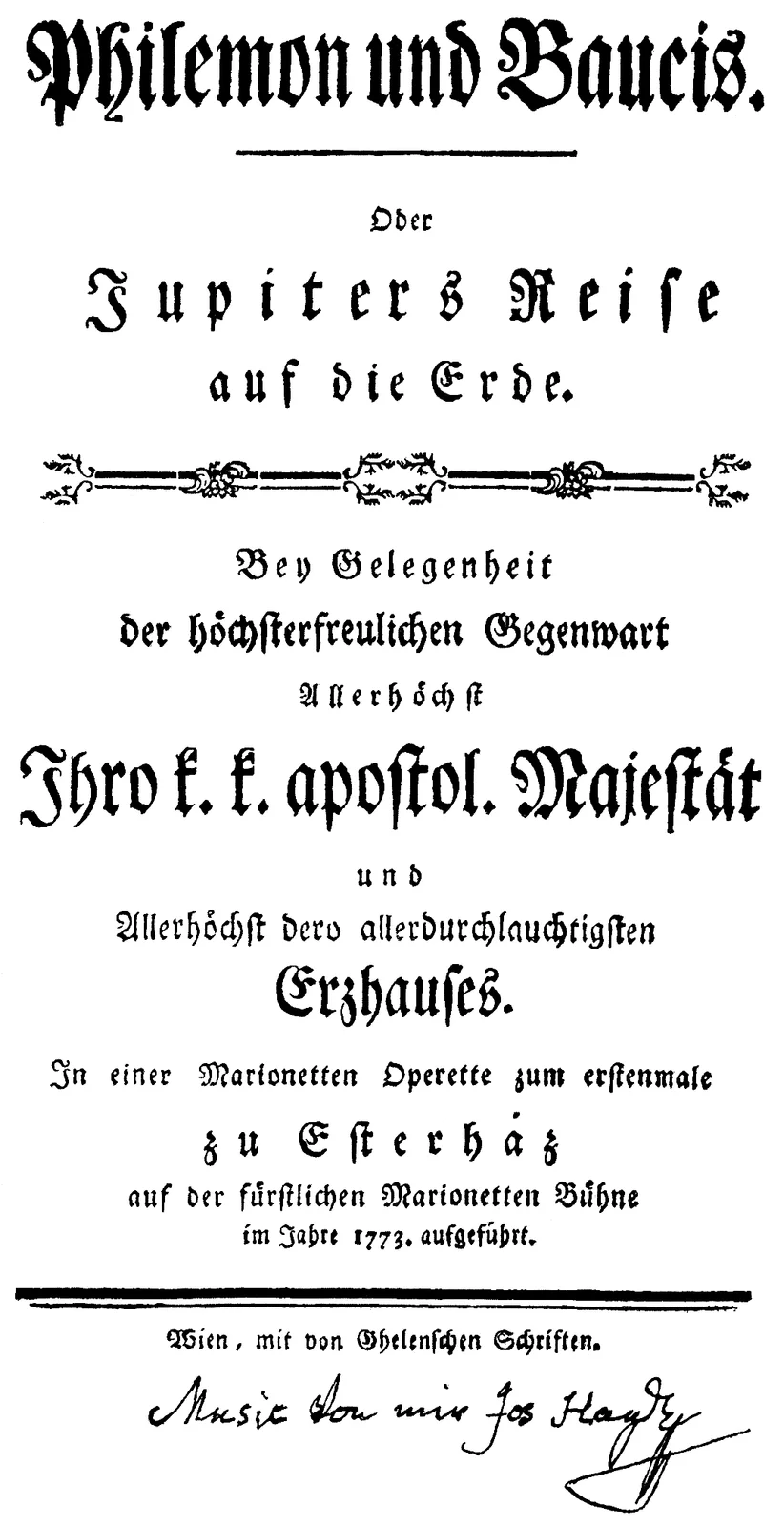
About the work
Haydn wrote this one-act marionette opera in 1773 for the new puppet theatre at Eszterháza; the libretto is an anonymous adaptation of a play by Gottlieb Konrad Pfeffel, sometimes attributed to the Esterházy librarian Philipp Georg Bader. It premiered on 2 September 1773 as part of the festivities for Empress Maria Theresa's visit to Eszterháza, during which Haydn's opera 'L'infedeltà delusa' was also performed.
Plot
Jupiter and Mercury descend to earth disguised as poor travellers to test humanity. Only the elderly, impoverished couple Philemon and Baucis receive them with hospitality. As a reward, the gods bring the couple's dead son and his bride back to life and transform their humble cottage into a temple.
Cultural significance
The finale originally closed with an apotheosis of the empress and the House of Habsburg, tailored to the occasion. Haydn reworked the piece into a full opera in 1776; a manuscript that surfaced at the Paris Conservatoire in 1950 restored sections long thought lost after an 1779 fire at Eszterháza.