About the work
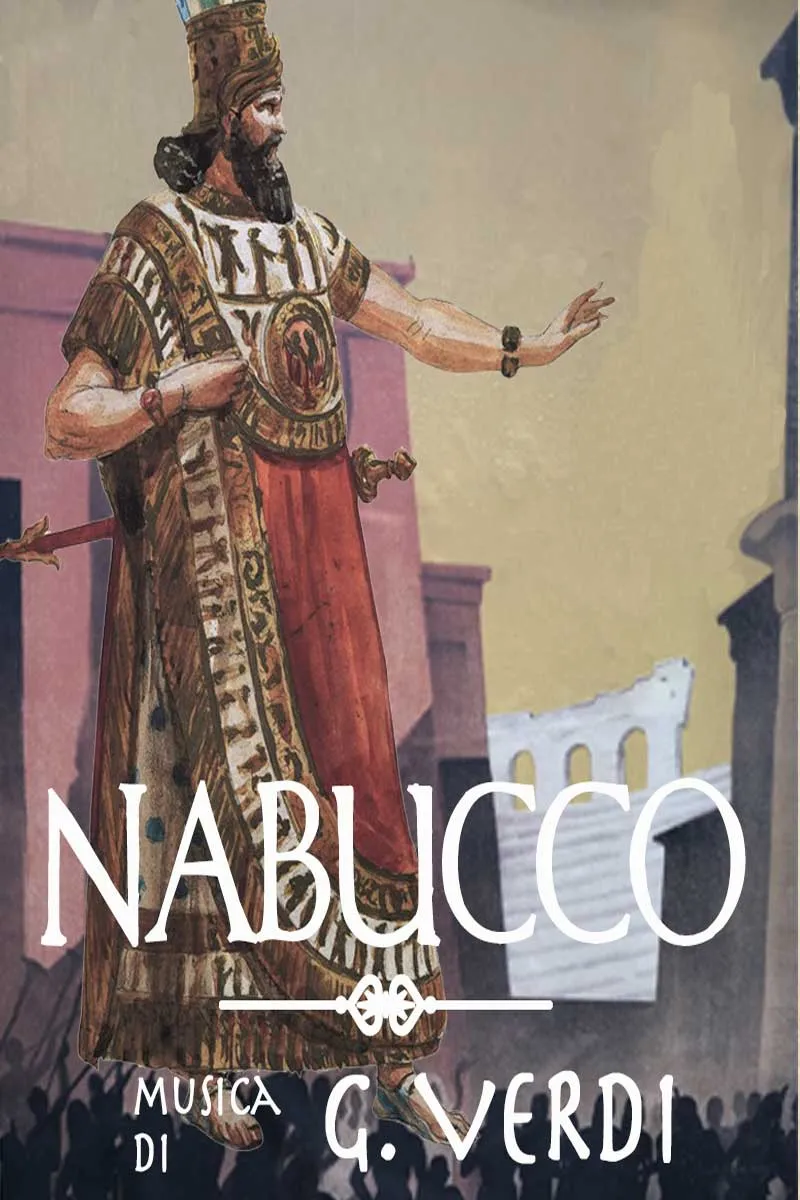
Nabucco is an opera in four parts by Giuseppe Verdi, premiered on 9 March 1842 at La Scala in Milan, and it rescued the twenty-eight-year-old composer from a profound personal and professional crisis. In the preceding years Verdi had lost his wife and both of his small children, and his previous opera, Un giorno di regno, had failed disastrously. Temistocle Solera's libretto, drawn from the Babylonian captivity of the Jews, pulled him out of despair and established the operatic voice that would define Italian musical theatre for half a century.
Plot
In biblical Babylon, King Nabucco (Nebuchadnezzar II) has conquered Jerusalem and taken the Hebrew people into slavery. His presumed daughter Abigaille discovers that she is in truth the daughter of a slave and plots to seize the throne. When Nabucco blasphemously proclaims himself God in the temple, a lightning bolt strikes him mad, and Abigaille rules in his place, ordering the execution of the captives. In captivity, the prophet Zaccaria leads the exiles in prayer. Nabucco regains his sanity by praying to the Hebrews' god, reclaims his throne, frees the captives, and orders the destruction of the idol of Baal. Abigaille, driven by remorse, takes poison and dies.
Cultural significance
Nabucco is the founding work of Verdi's career and contains Va, pensiero, sull'ali dorate, the chorus of the Hebrew slaves longing for their lost homeland. The melody became an unofficial anthem of the Italian Risorgimento, the nineteenth-century unification movement, and was sung again at Verdi's funeral in 1901. At the 2011 La Scala premiere of a new production, conductor Riccardo Muti called for and received an unprecedented audience encore of Va, pensiero amid public debate over cuts to Italian cultural funding. The role of Abigaille, with its extreme leaps and dramatic outbursts, is regarded as one of the most demanding dramatic soprano parts in the entire repertoire.