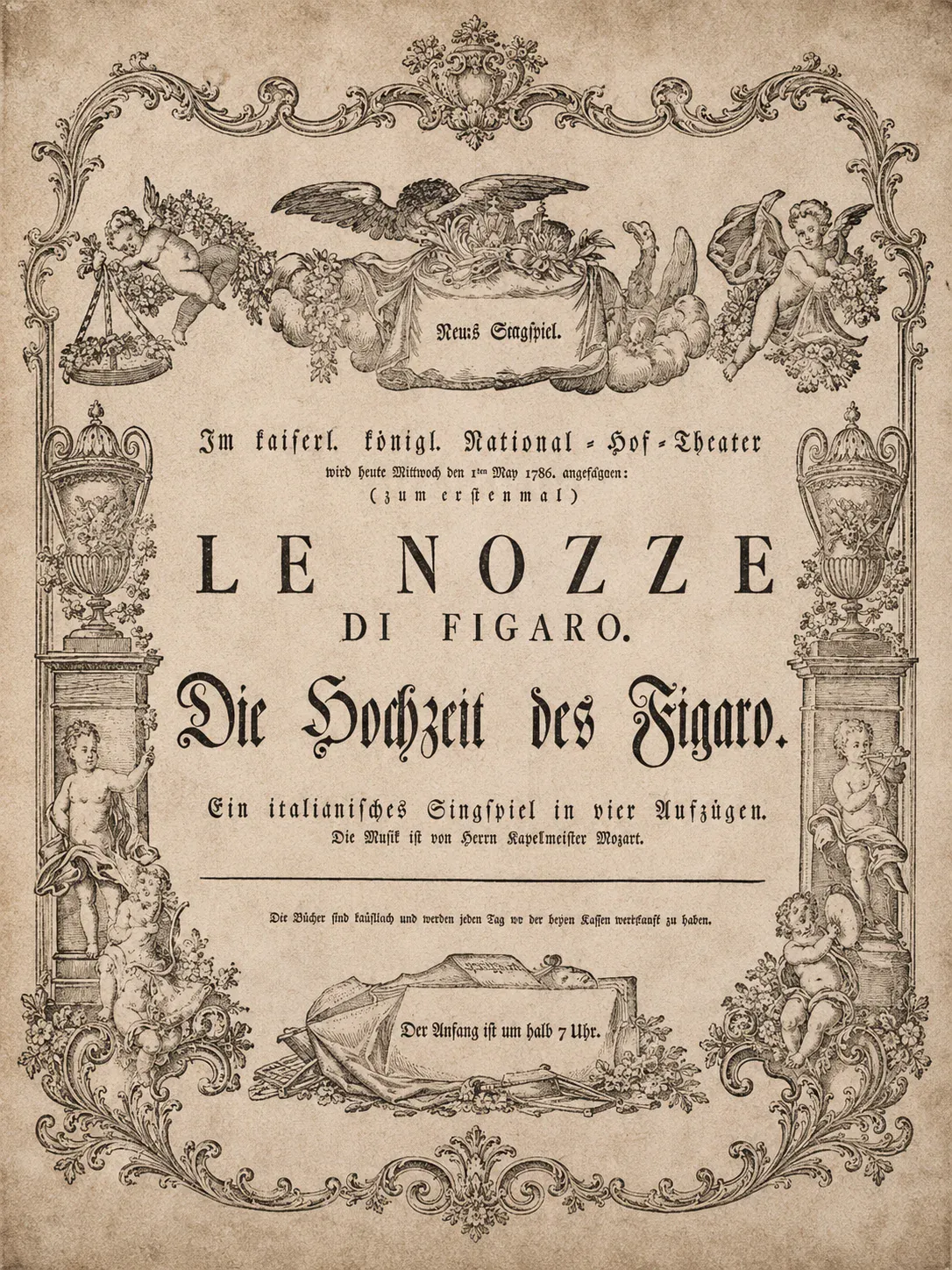
About the work
Mozart and Lorenzo da Ponte's „Le nozze di Figaro" was premiered in Vienna in 1786 — the first of the three great Da Ponte operas. The libretto is based on Pierre-Augustin Caron de Beaumarchais's comedy „La folle journée, ou Le mariage de Figaro" (1784), initially banned in France for its political volatility.
Plot
The castle of Count Almaviva in Seville, a single day (hence Beaumarchais's subtitle „the mad day"). The servant Figaro wants to marry the maid Susanna, but the Count — who has officially abolished the old „droit du seigneur" — secretly wants to seduce Susanna. Figaro, Susanna, the Countess neglected by the Count, and the page Cherubino spin a web of intrigue: Susanna is to grant the Count an assignation, to which however the Countess will appear disguised as Susanna. Cherubino — in love with all women, especially the Countess — complicates everything. Marcellina, an aging housekeeper, claims Figaro through an old debt — until it is revealed: she is Figaro's mother and Bartolo his father. In the nocturnal garden scene the disguised couples cross paths: the Count courts the supposed Susanna (actually his wife), Figaro feigns jealousy. Finally the Count recognises his wife, kneels before her, begs forgiveness — the Countess grants it in one of the most moving final scenes in operatic history: „Più docile io sono".
Cultural significance
Le nozze di Figaro is the most-performed Mozart opera and is considered by many the greatest comedy in operatic history. The overture, Cherubino's „Voi che sapete" and „Non so più", the Countess's „Porgi amor" and „Dove sono", the Susanna duet „Sull'aria" and the final forgiveness ensemble belong to world cultural heritage. Beaumarchais's political force (servant against master) was softened by Mozart and da Ponte but remains perceptible — the French Revolution came three years later. Productions by Giorgio Strehler, Peter Sellars (modern setting in Trump Tower!), Michael Hampe, Claus Guth shape the performance tradition.