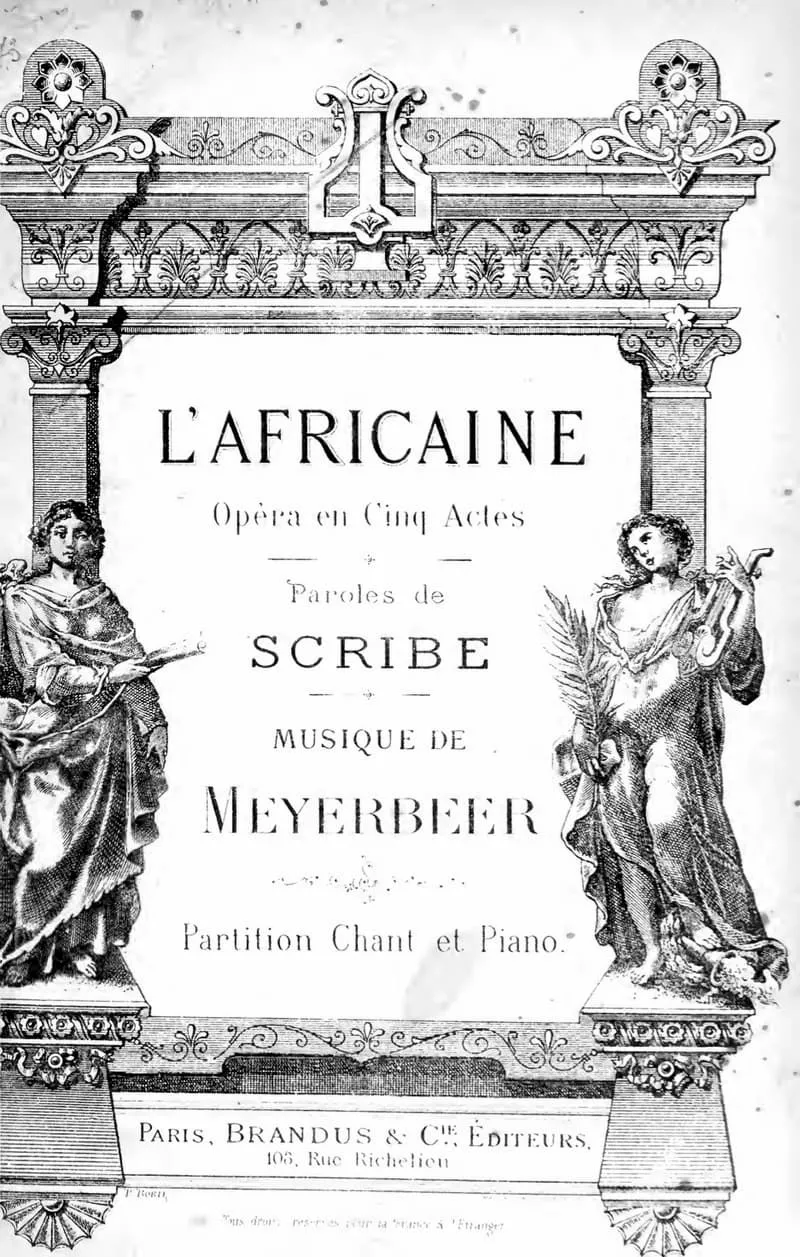
About the work
L'Africaine (The African Woman) is a grand opera in five acts by Giacomo Meyerbeer to a libretto by Eugène Scribe, premiered posthumously in 1865 at the Paris Opera. It was Meyerbeer's last work, on which he laboured until his death, and is among the most ambitious creations of grand opera.
Plot
The opera links the story of the Portuguese explorer Vasco da Gama with a tragic love. From his sea voyages Vasco brings back the captive slave Sélika, who is in truth a queen from a distant land and loves him. Vasco, however, loves the noblewoman Inês. Between the spirit of discovery, colonial drama, jealousy, and intrigue, Sélika's tragic fate unfolds: so as not to stand in the way of Vasco's happiness with Inês, she finally takes her own life by inhaling the poisonous scents of the manchineel tree.
Cultural significance
L'Africaine is famous for the radiant tenor aria O paradis and for the exotic, colourful tableaux that reflect the nineteenth century's colonial wanderlust. As Meyerbeer's swan song, the work unites the monumental means of grand opera with lyrical intimacy. Although performed less often today, it is regarded as an important document of operatic history and occasionally enjoys acclaimed rediscoveries.