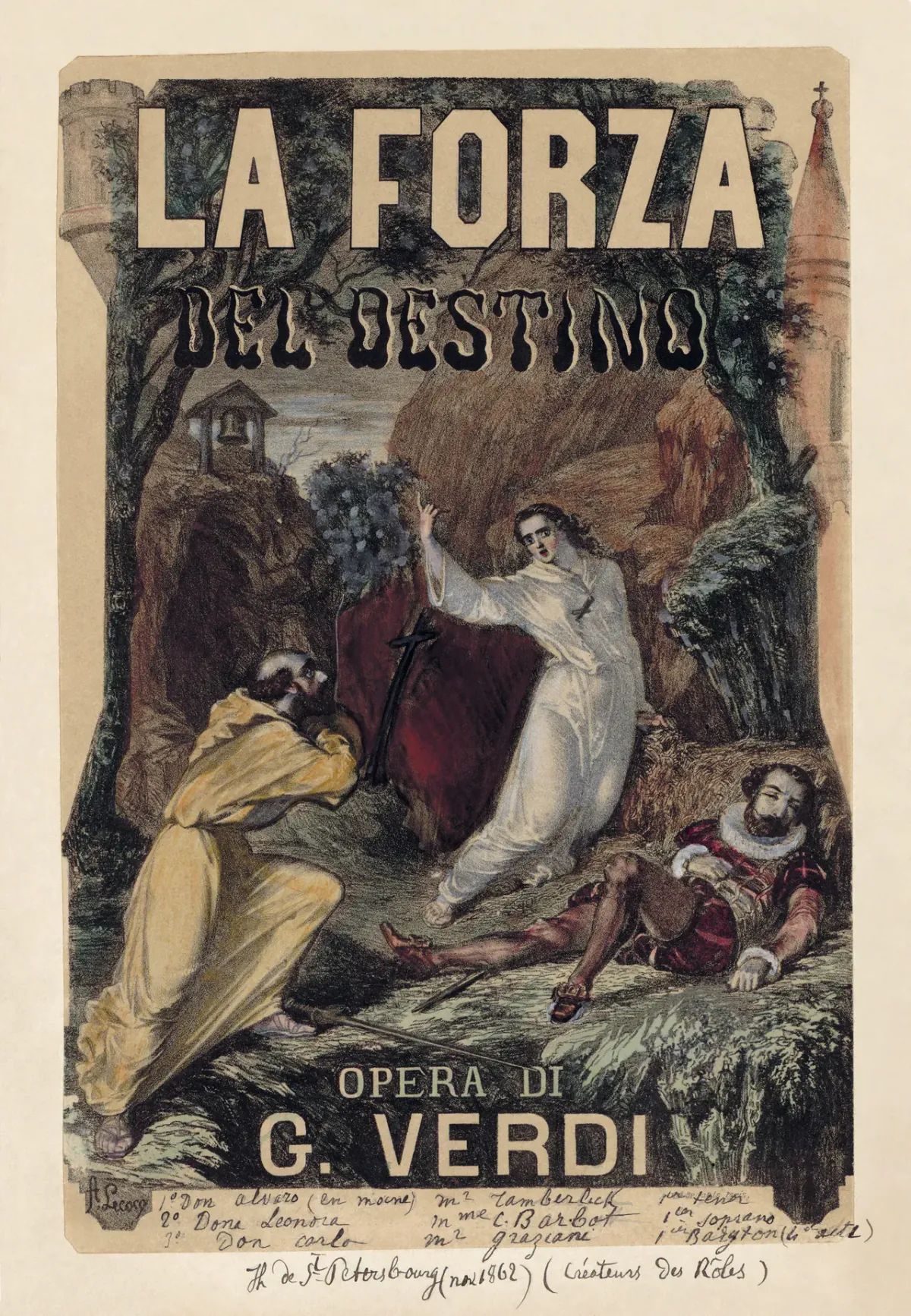
About the work
Giuseppe Verdi's sprawling four-act opera was premiered on 10 November 1862 at the Imperial Theatre Saint Petersburg—a commission from the Russian court that Verdi accepted for an unprecedented fee. Verdi revised the work substantially in 1869 for La Scala Milan, toning down the notorious original ending (a triple suicide) into the more dignified tragic closure heard today. The libretto by Francesco Maria Piave is based on a Spanish drama by the Duke of Rivas.
Plot
The young nobleman Don Alvaro elopes with Leonora, daughter of the Marchese di Calatrava, against her father's wishes. A pistol accident during their escape kills the Marchese; his dying curse sets the opera's events in motion. Separated, Leonora takes refuge in a monastery while Alvaro seeks death in war. Her brother Don Carlo has sworn vengeance. Years pass across battlefields, monasteries, and disguises until Alvaro and Carlo duel; Leonora, emerging from her solitude to defend Alvaro, is stabbed by her dying brother. In the revised ending, Alvaro accepts his fate and Leonora dies in his arms.
Cultural significance
La Forza del Destino has attracted a famous superstition: it is said to be cursed, with multiple deaths, injuries, and disasters plaguing productions across its history. The Overture is among the most frequently performed orchestral Verdi excerpts. The opera demands three principals of extraordinary force—Leonora, Alvaro, Carlo—each with extended dramatic arias. Christof Loy's production at the Royal Opera House and Martin Kušej's at the Bayerische Staatsoper have emphasised the work's meditation on fate, chance, and the inescapability of the past.