About the work
Hector Berlioz's „La Damnation de Faust" was premiered in Paris in 1846 — as a „dramatic legend", not an opera in the classical sense. Berlioz conceived the work as a concert piece that can also be performed scenically. The libretto by Berlioz and Almire Gandonnière is based on Goethe's „Faust I" (first edition 1808) in Gérard de Nerval's French translation.
Plot
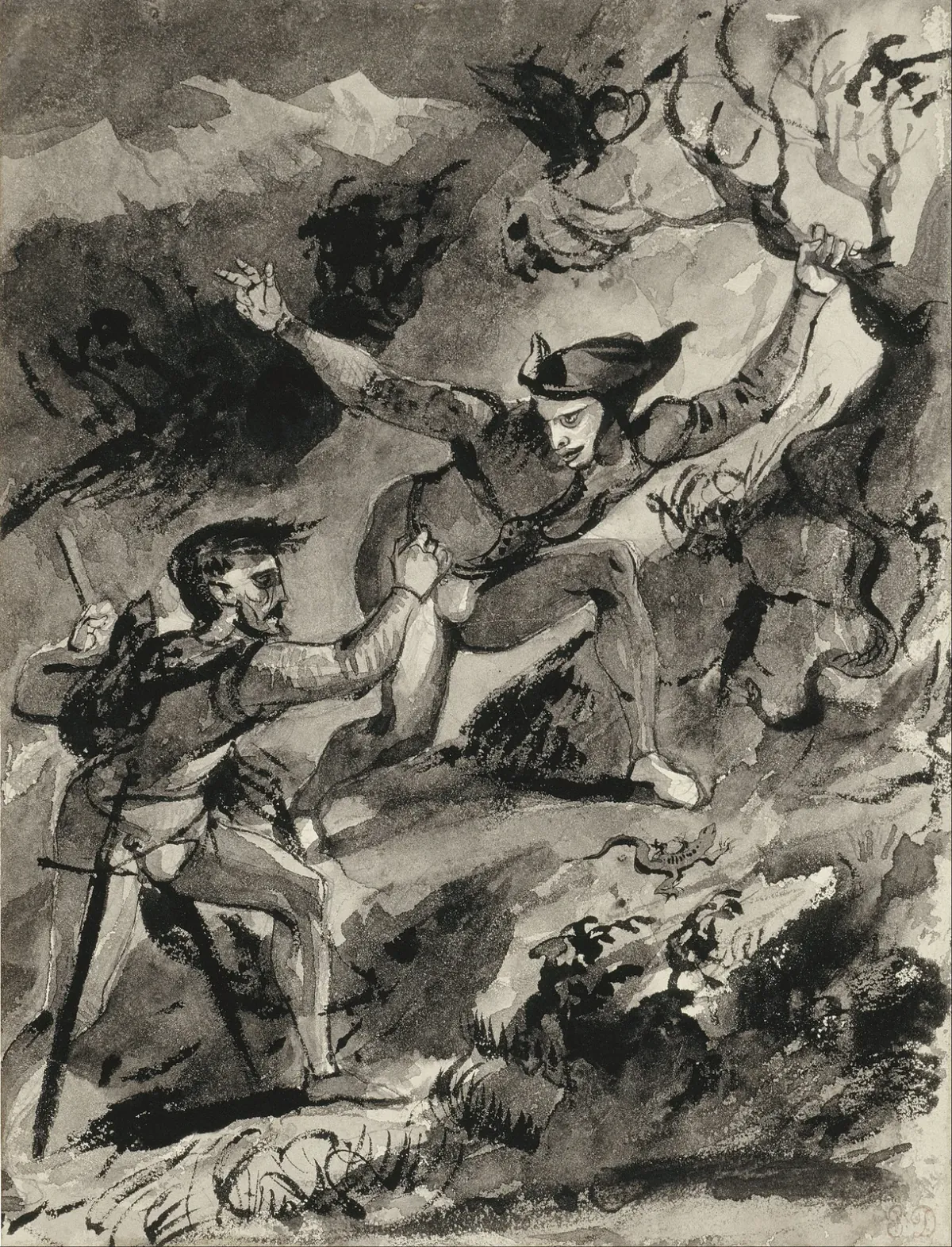
Faust, the dissatisfied scholar, seeks meaning and love. On the Hungarian plains he listens to the Rákóczi March (Berlioz's homage to Hungary, more concert piece than plot). In his study he is about to drink poison; Mephistopheles appears and offers him experiences. They travel to Auerbach's cellar (drinking song „Voici des roses"), to a ghost-sea vision, and finally to Marguerite. Faust seduces Marguerite, who falls in love with him. Mephistopheles promises her a sleeping draught — she is to put her mother to sleep so Faust may come. The draught kills the mother. Marguerite, pregnant and in madness, drowns the child and is condemned to death. Faust, driven by remorse, signs a pact — Mephistopheles is to take him to hell to save Marguerite. Mephistopheles carries Faust on a famous ride to the abyss („Course à l'abîme") into damnation. In the closing scene Marguerite is borne aloft by angels into heaven.
Cultural significance
La Damnation de Faust is Berlioz's most important vocal work alongside „Les Troyens" and his most ambitious Goethe adaptation. The Rákóczi March, the rat's drinking song, Marguerite's romance „D'amour l'ardente flamme" and the ride to the abyss are concert classics. Concert performances are more frequent than scenic ones — Robert Lepage's 2008 Met production with its projected imagery is a modern reference. Berlioz's choice of material — Marguerite's redemption despite infanticide, Faust's damnation — diverges radically from Goethe's „Faust II".