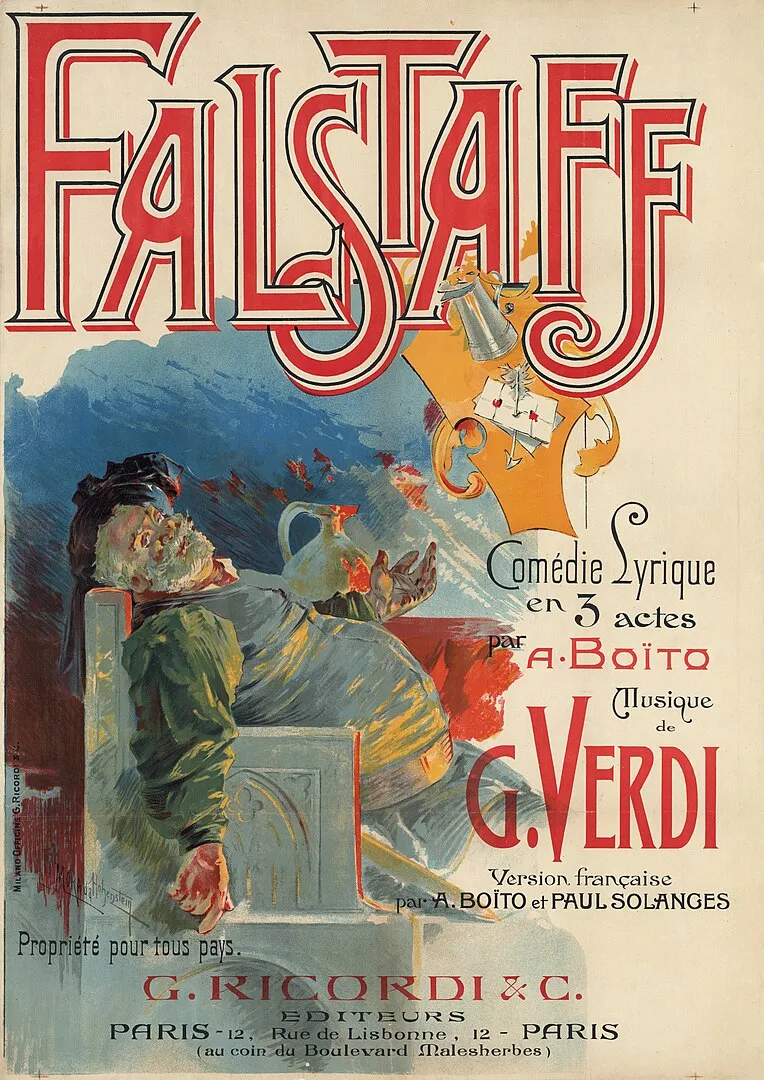
About the work
Giuseppe Verdi's only mature comic opera, with a libretto by Arrigo Boito after Shakespeare's Merry Wives of Windsor and Henry IV, was premiered on 9 February 1893 at La Scala Milan. Verdi was seventy-nine at the premiere; it was his final opera, composed purely for artistic pleasure rather than commission. The work is a miracle of late style—compressed, witty, through-composed, and infused with the lightness of final serenity.
Plot
Sir John Falstaff, the impoverished and self-deluded knight, has sent identical love letters to two wealthy women of Windsor, Alice Ford and Meg Page. Recognising the scheme, the women plot elaborate revenge with Alice's husband Ford, who has his own jealous suspicions. In a sequence of escalating humiliations, Falstaff is dumped into the Thames hidden in a laundry basket, beaten while disguised as an old woman, and finally lured at midnight to Windsor Forest where masked townspeople torment him as Herne the Hunter. The young lovers Nannetta and Fenton are united against Ford's opposition. Falstaff recovers his humour and leads the company in the final fugue: Tutto nel mondo è burla—all the world's a jest.
Cultural significance
Falstaff is the great final flowering of Italian operatic comedy and exerted enormous influence on subsequent composers, from Strauss through Britten. The closing fugue, with all characters proclaiming that life is a great joke, has become a signature moment of nineteenth-century art. The title role, a substantial baritone part, has attracted artists from Tito Gobbi through Geraint Evans to Bryn Terfel. Productions by Robert Carsen at Covent Garden and Damiano Michieletto at La Scala have kept the work central to the contemporary repertoire.