About the work
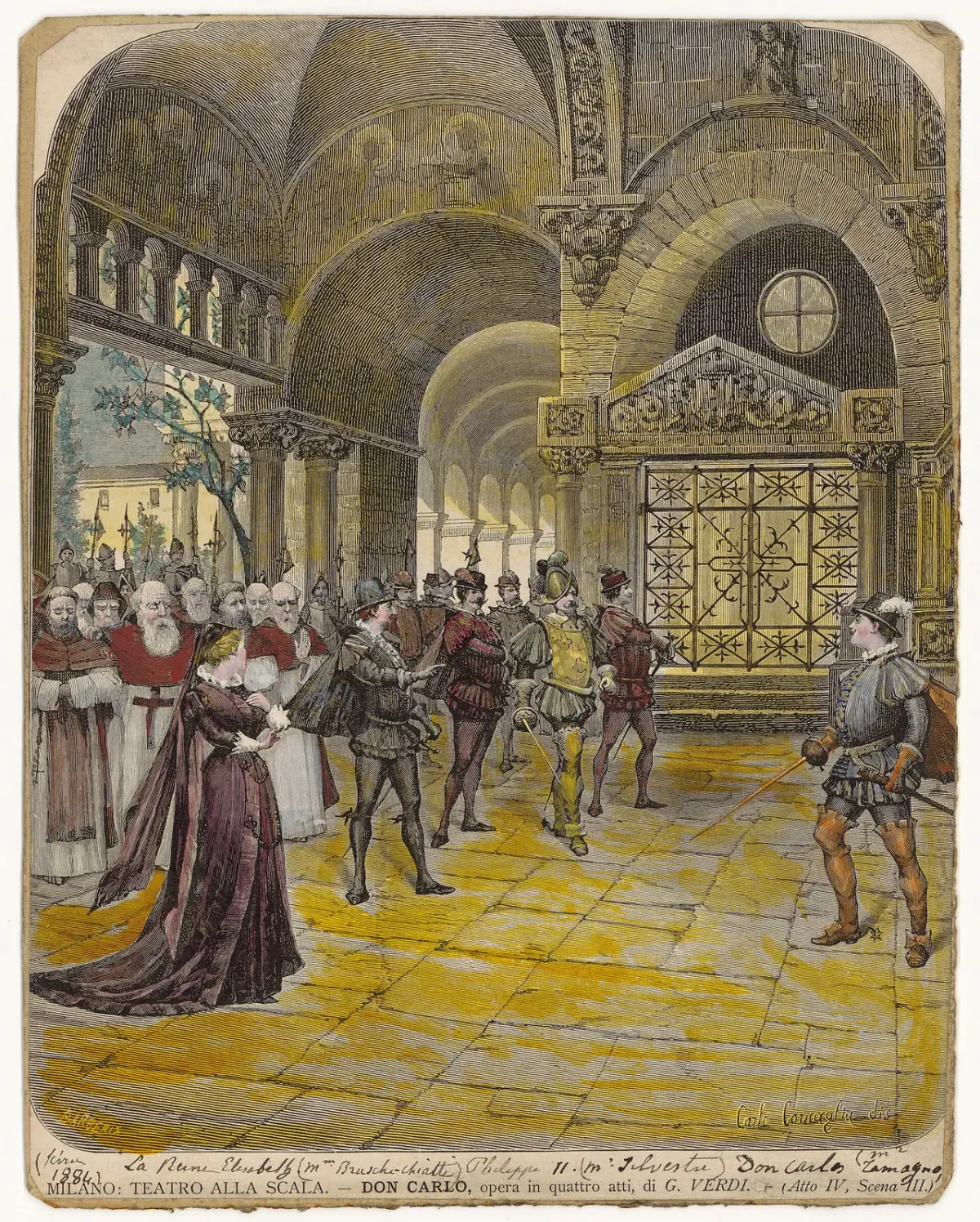
Giuseppe Verdi's grand opera in five acts exists in multiple versions—originally composed in French as Don Carlos for the Paris Opéra premiere in 1867, later revised in Italian as Don Carlo. Based loosely on Friedrich Schiller's play Don Carlos, the work dramatises political and religious oppression in sixteenth-century Spain through one of the most intimate operatic portraits of family tragedy. The standard Italian four-act Milan version of 1884 and the original French five-act version both remain in the repertoire.
Plot
Don Carlos, heir to the Spanish throne, loves Elisabeth de Valois—but she is married to his father King Philip II for political reasons. The Spanish Inquisition, embodied by the blind Grand Inquisitor, suppresses the kingdom with terror. Carlos's friend Rodrigo, Marchese di Posa, works secretly for the liberation of Flanders. Princess Eboli, jealous of Elisabeth, denounces the lovers to Philip. Posa is assassinated to protect Carlos. In the climactic confrontation at the tomb of Emperor Charles V, a mysterious monk—hinted to be the ghost of Charles himself—draws Carlos into the shadows, leaving the fate of Flanders and the love story ambiguous.
Cultural significance
Don Carlo is Verdi's most philosophically ambitious work and one of the most frequently performed grand operas. Philip II's monologue Ella giammai m'amò is among the great bass arias. The opera demands six world-class principals across bass, baritone, tenor, soprano, and two mezzos—making it a central showpiece for great opera houses. Productions by Luchino Visconti at Covent Garden and Stéphane Braunschweig at the Salzburg Festival have shaped modern interpretation.