About the work
A five-act drama in prose and verse by the Spanish writer and statesman Ángel de Saavedra, Duke of Rivas, first performed on 22 March 1835 at the Teatro del Príncipe in Madrid. Rivas had drafted an earlier prose version in 1832 while in exile in Tours, France; after losing that manuscript he rewrote the play, mixing prose and verse in a form unusual for the Spanish stage at the time. Its premiere is regarded as the breakthrough of literary Romanticism in Spanish theatre.
Plot
The wealthy Don Álvaro, of unknown origin, loves the noblewoman Doña Leonor, whose father, the Marqués de Calatrava, rejects the match. During the lovers' attempted elopement, a pistol dropped by Álvaro discharges and kills the Marqués; the couple is separated, Leonor retreats to live as a hermit, and Álvaro joins the army. Over the following years Leonor's brothers hunt him for revenge, until both brothers and Leonor are dead and Álvaro throws himself from a cliff.
Cultural significance
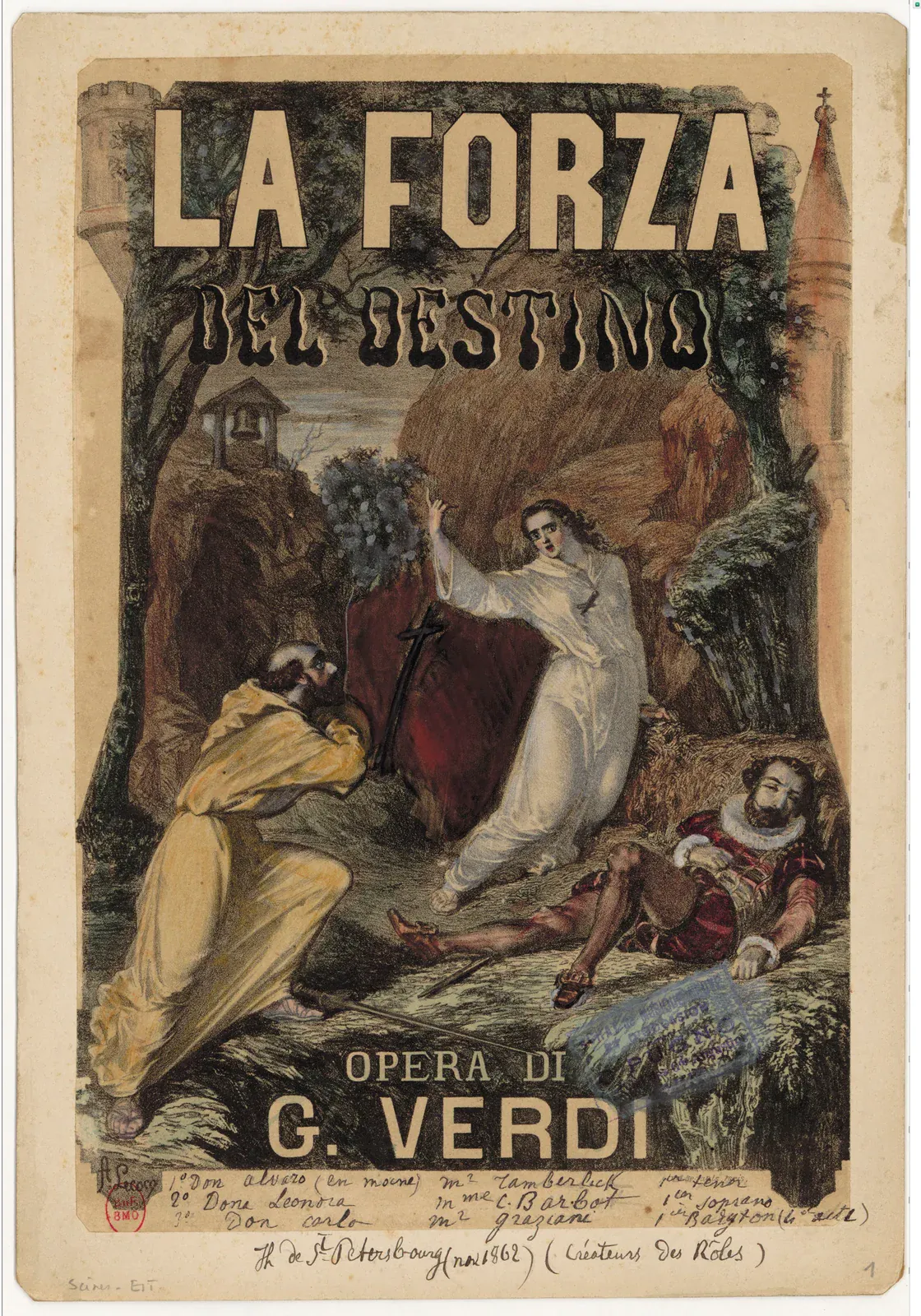
The play broke Spanish theatre free of neoclassical convention and, alongside Victor Hugo's "Hernani", is regarded as a key work of European Romantic drama. In 1862 Giuseppe Verdi turned the story into the opera "La forza del destino", bringing it worldwide fame.