About the work
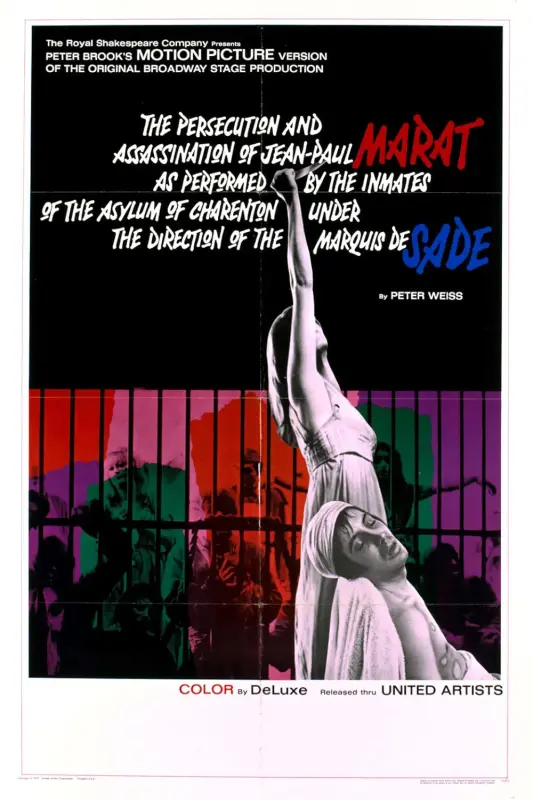
Peter Weiss's „The Persecution and Assassination of Jean-Paul Marat as Performed by the Inmates of the Asylum of Charenton under the Direction of the Marquis de Sade" was premiered in Berlin in 1964. Known as „Marat/Sade", the play is a theatre within a theatre, combining Brecht's epic theatre with Antonin Artaud's „theatre of cruelty".
Plot
In 1808 the inmates of the asylum of Charenton, directed by the interned Marquis de Sade, perform a play — before the asylum director Coulmier and his family. The subject is the murder of the revolutionary Jean-Paul Marat by Charlotte Corday in 1793. Marat sits, afflicted by a skin disease, in his bathtub and dictates his fiery writings; Corday approaches him three times before she stabs him. Over the historical events lies a great dispute between Marat, the advocate of radical revolution and collective liberation, and de Sade, the sceptical individualist who believes only in the suffering and drives of the single human being. Choruses, songs and the repeatedly erupting inmates break open the form; at the end the staged revolt threatens to turn into a real one.
Cultural significance
„Marat/Sade" is a key work of the political theatre of the 1960s and poses the still-open question of revolution and the individual, idealism and resignation. Peter Brook's 1964 London production for the Royal Shakespeare Company and its 1967 film are regarded as legendary and left a lasting mark on world theatre.