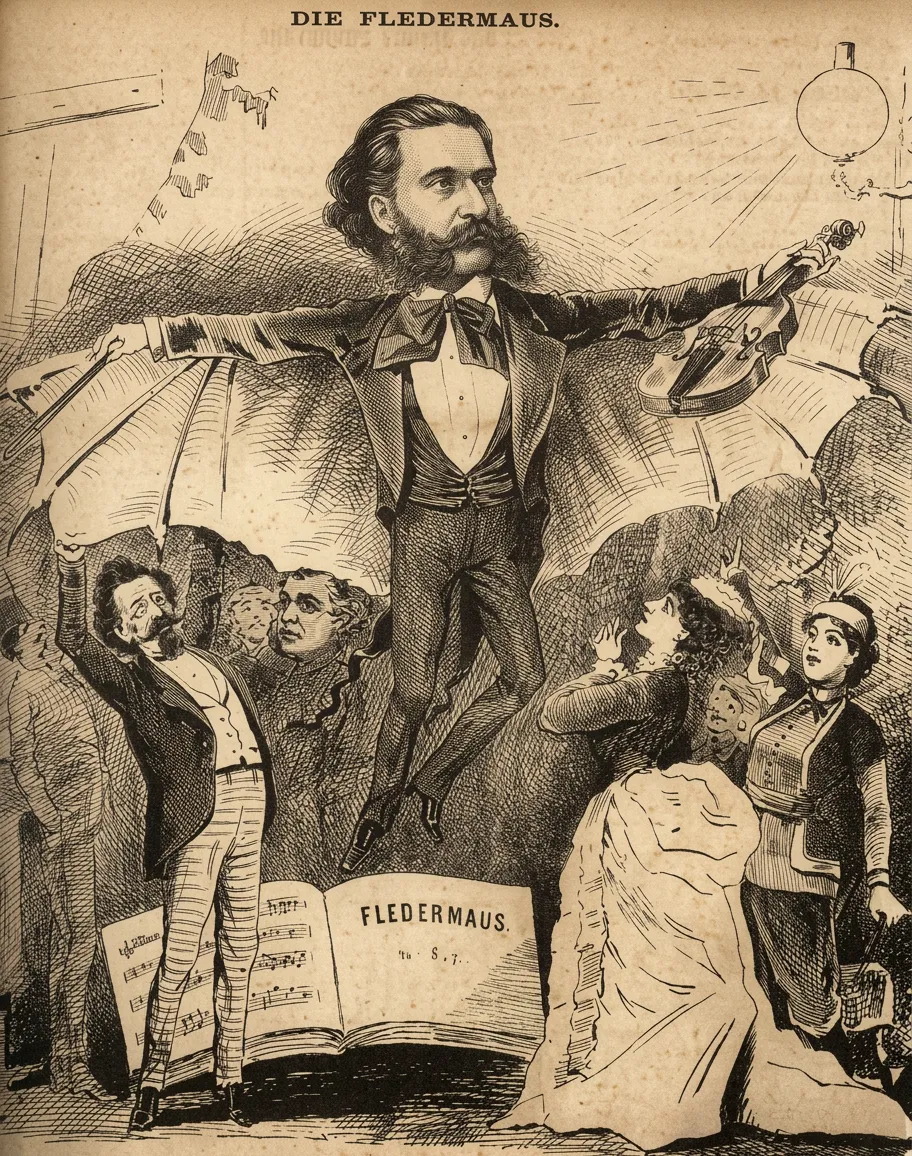
About the work
Johann Strauss II's three-act operetta was premiered in 1874 at the Theater an der Wien—the work that secured operetta's place as the defining Viennese theatrical form. The libretto by Karl Haffner and Richard Genée, adapted from a French vaudeville Le Réveillon, is a comedy of elaborate masked-ball revenge in the high bourgeoisie of the late Habsburg Empire. The work is one of the most frequently performed operettas in the world, with particular New Year's Eve associations.
Plot
Gabriel von Eisenstein is sentenced to jail for insulting an official but delays his arrival to attend Prince Orlofsky's masked ball. His wife Rosalinde, tipped off by the conniving Dr. Falke, attends the same ball in disguise as a Hungarian countess to expose her husband's flirtations. Her lover Alfred, who has arrived to serenade her, is mistakenly arrested in Eisenstein's place. At the ball, Eisenstein unknowingly flirts with his own disguised wife. Everyone retrieves to the jail where the warden Frosch provides drunken comic relief. Identities are revealed; Falke's elaborate revenge for a past humiliation is complete; all is forgiven as everyone blames the champagne.
Cultural significance
Die Fledermaus is the supreme Viennese operetta and has remained a fixture of international repertoires, especially at New Year's Eve when the Wiener Staatsoper's traditional performance is broadcast worldwide. The work's concept of a guest star appearing at Orlofsky's ball to sing a cameo piece has become a beloved tradition, with appearances ranging from Birgit Nilsson through Plácido Domingo to Juan Diego Flórez. The Csárdás and the Champagne finale are among the most beloved moments in all operetta.