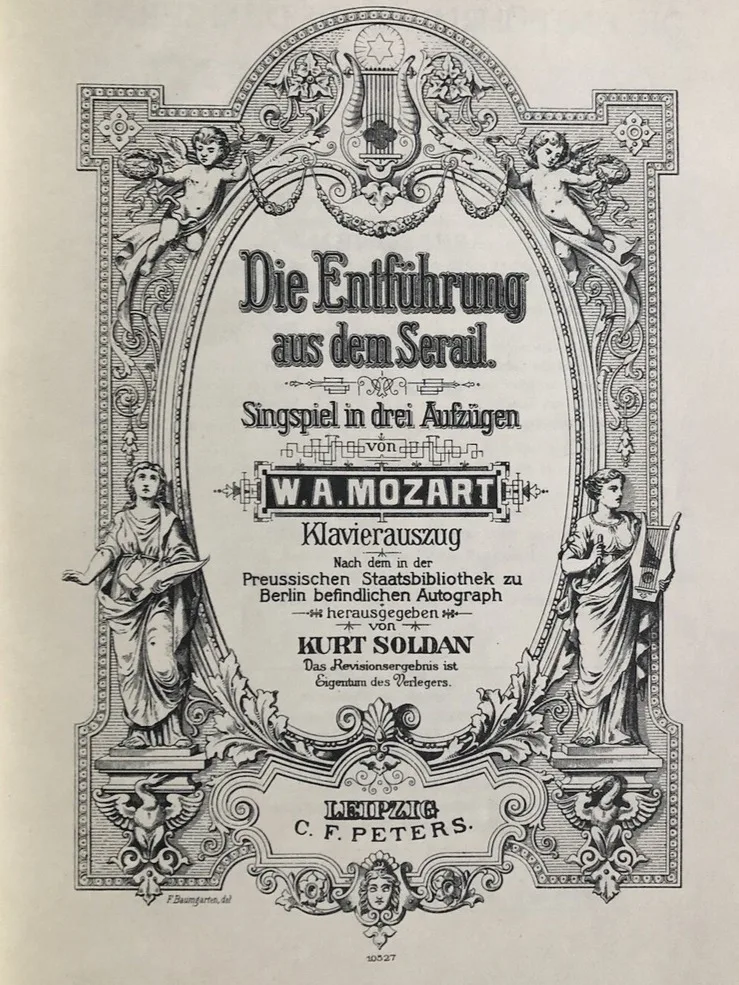
About the work
Mozart's three-act singspiel was premiered on 16 July 1782 at the Burgtheater Vienna—his first major operatic success in the imperial capital and the work that established Mozart as a mature operatic composer. The libretto by Gottlieb Stephanie, loosely adapted from Christoph Friedrich Bretzner, fits into the turquerie vogue of the late eighteenth century while treating its Ottoman setting with unusual complexity for its era.
Plot
The Spanish nobleman Belmonte arrives at the palace of Pasha Selim to rescue his beloved Constanze, who has been captured by pirates and enslaved. With his comic servant Pedrillo and help from the English maid Blonde—beloved of Pedrillo and pursued by the comic villain Osmin—Belmonte plots an elaborate rescue. When the plan is discovered, Pasha Selim reveals that Belmonte's father had long ago ruined him and driven him into exile. But rather than take vengeance, the Pasha grants the European couples their freedom and their lives as a gesture of magnanimity that shames Belmonte's vengeful father.
Cultural significance
Die Entführung features Mozart's first fully realized comic villain Osmin, whose bass aria O, wie will ich triumphieren descends to the celebrated low D—a note that has separated great Osmins from ordinary ones for two centuries. The work inaugurated the German-language operatic tradition that would lead through Die Zauberflöte to Der Freischütz and Wagner. Emperor Joseph II is said to have remarked to Mozart after the premiere: 'Too many notes, my dear Mozart'—to which the composer allegedly replied, 'Just as many as necessary, Your Majesty.'