About the work
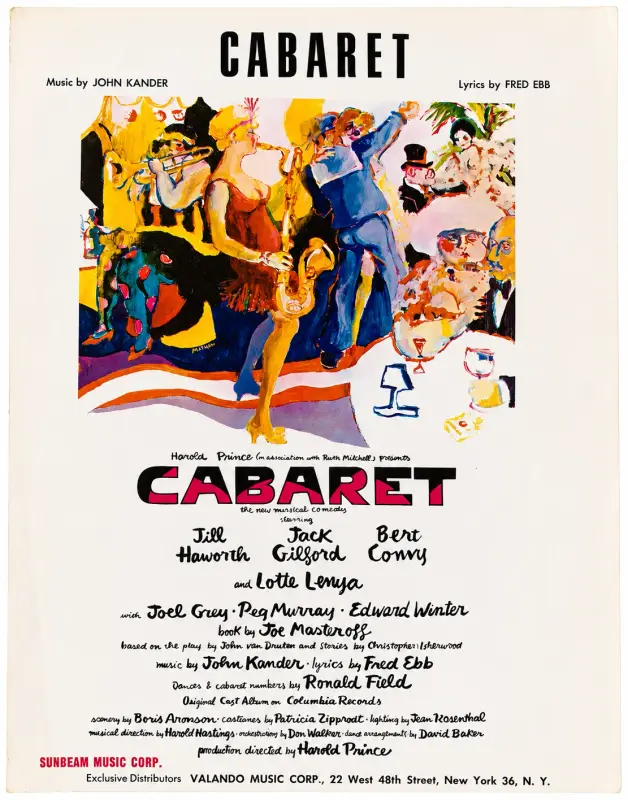
John Kander and Fred Ebb's musical „Cabaret" was premiered on Broadway in 1966 with book by Joe Masteroff. The work is based on Christopher Isherwood's stories „The Berlin Stories" (1939) and on John Van Druten's stage adaptation „I Am a Camera" (1951). The musical depicts Berlin's nightlife in 1930-31 against the backdrop of the rising Nazi movement.
Plot
Berlin, end of 1930. The young American writer Cliff Bradshaw arrives in Berlin to write a novel. He stops at the boarding house of Fräulein Schneider, where the elderly Jewish fruit-seller Herr Schultz is wooing Schneider. Cliff goes to the Kit Kat Klub, a decadent nightclub presided over by the androgynous Master of Ceremonies (Emcee). There he meets the British singer Sally Bowles. Sally moves into Cliff's room; they have a relationship; she becomes pregnant. Cliff's friend Ernst Ludwig, a businessman, turns out to be a Nazi who smuggles money from Paris for the party. Schneider and Schultz become engaged — but break off the engagement when Schneider sees what awaits Schultz under the Nazis. Cliff wants to take Sally with him to Paris. Sally, fleeing into illusion, has the abortion alone, returns to the Kit Kat Klub: „Life is a cabaret, old chum." Cliff travels alone to Paris.
Cultural significance
Cabaret is one of the most theatrically and politically ambitious musicals. The Emcee — played by Joel Grey (premiere, film), Alan Cumming, Eddie Redmayne — has become a cultural icon. Bob Fosse's 1972 film won eight Oscars (Liza Minnelli as Sally Bowles). „Wilkommen", „Money, Money", „Mein Herr", „Maybe This Time" and the title song are popular-music classics. Sam Mendes's 1993 production transformed the musical into much darker terrain.