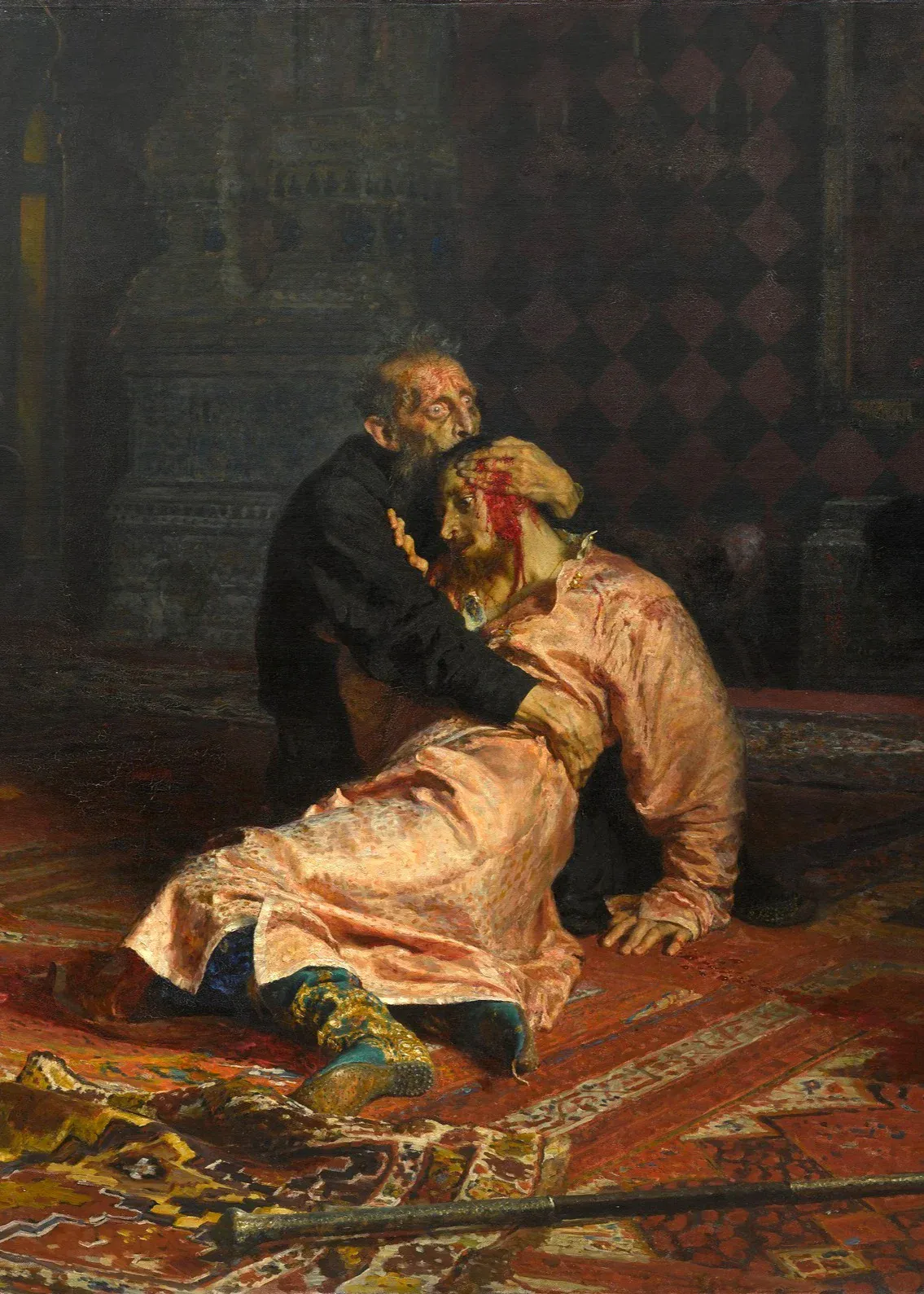
About the work
Modest Mussorgsky's opera in four acts and a prologue is regarded as the most important Russian stage work of the nineteenth century. Mussorgsky produced several versions (rejected 1869, accepted 1872, premiered 1874 in St Petersburg). The libretto — written by the composer himself after Pushkin's play of the same name (1825) and Karamzin's history of Russia — dramatises the „Time of Troubles" between 1598 and 1605.
Plot
After the death of the childless Tsar Fyodor, Boris Godunov has himself crowned tsar. Rumours circulate that he has had the young heir Dmitri Ivanovich murdered. In the Chudov Monastery the young monk Grigori Otrepyev learns the story from the old Pimen and decides to pose as the rescued Dmitri. He flees to Poland, wins the love of Marina Mniszech and marches with Polish troops on Moscow. Boris, tortured by guilt and hallucinations — he sees the murdered child — collapses in the Kremlin and dies in the arms of his son Fyodor, to whom he entrusts Russia. The closing scene of the popular uprising in the Kromy forest shows the rebels advancing on Moscow with the False Dmitri; a holy fool laments Russia's uncertain fate.
Cultural significance
Boris Godunov is the supreme Russian popular tragedy in operatic history and a formative model for the works of Shostakovich and Soviet opera. Mussorgsky's radical declamation, the powerful choral writing for the people (the coronation scene) and Boris's psychological monologues (the death scene) had an influence far beyond Russia. Rimsky-Korsakov's „tidied" version long dominated the stage, but today the composer's original versions are usually performed — most often the second (1872), which includes the Polish act.