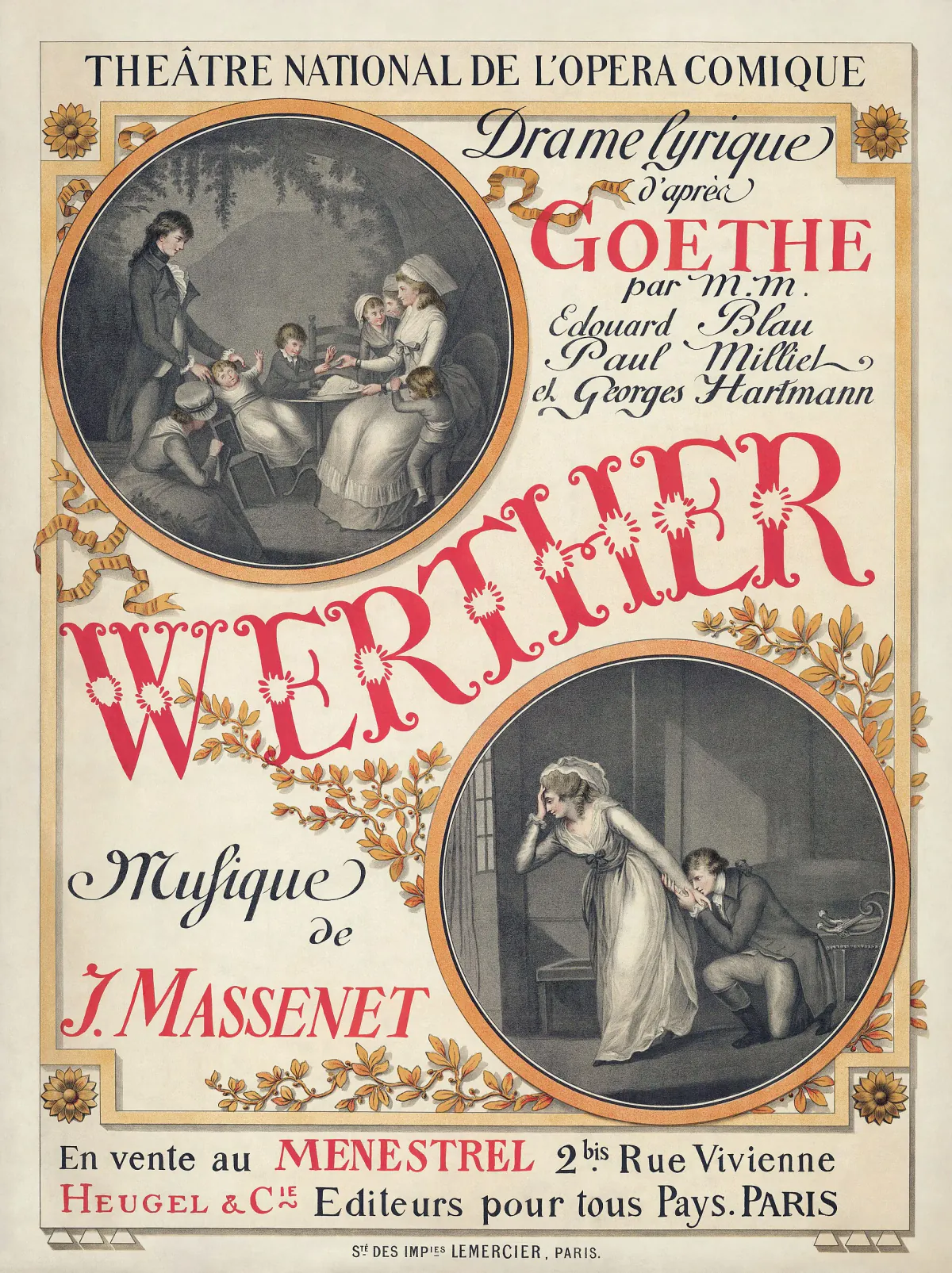
About the work
Jules Massenet's four-act opera was premiered in a German-language version on 16 February 1892 at the Hofoper Wien—the house had requested a new work after the Paris Opéra-Comique rejected the score as too dark. The French premiere followed in 1893. Based on Goethe's epistolary novel Die Leiden des jungen Werthers of 1774, the opera distills Goethe's revolutionary Sturm-und-Drang text into one of the most intensely lyrical operas of the French repertoire.
Plot
In an idyllic German village, the young poet Werther falls in love with Charlotte, who has been promised to the pragmatic Albert. She marries him out of duty, and Werther departs in despair. Returning at Christmas, Werther finds the couple in a settled domestic life—and Charlotte still loved by him. In the Ossian scene, Werther reads to her his translation of the Scottish bard, and their long-suppressed emotions explode. Werther borrows pistols from Albert on a pretext and shoots himself. Charlotte arrives in time to hear him confess his love once more before dying in her arms; outside, church bells ring for Christmas Eve.
Cultural significance
Werther is Massenet's most concentrated masterpiece and among the most emotionally direct works in the French operatic repertoire. The Ossian aria Pourquoi me réveiller is a touchstone of the lyric tenor repertoire. The title role has been defined by great French tenors from Jacques Urlus and Georges Thill through Alfredo Kraus, Roberto Alagna, and Jonas Kaufmann. The opera's Christmas Eve setting makes it a seasonal favourite in some houses, though its tragic intensity places it firmly in the tradition of adult operatic drama.