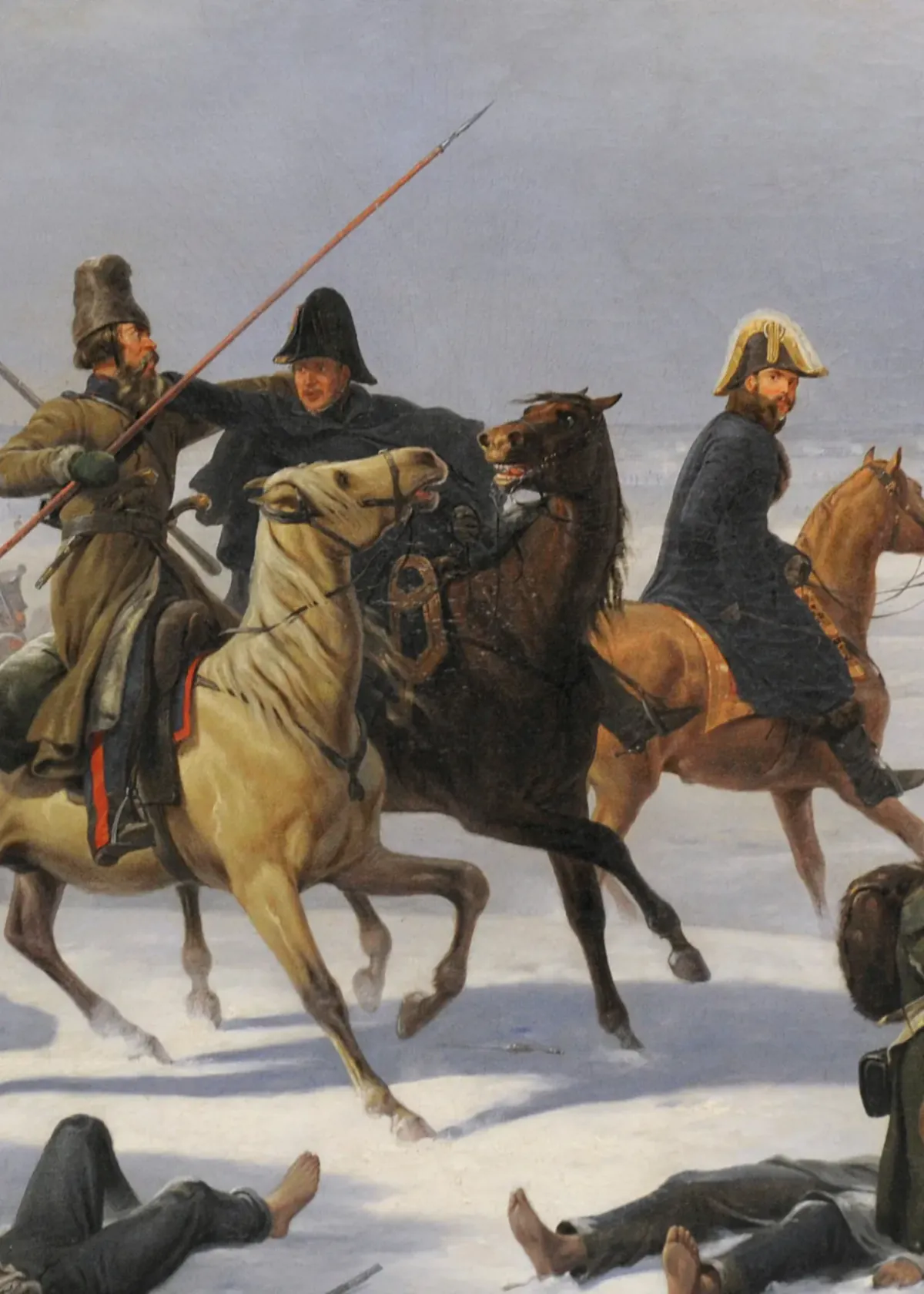
About the work
Sergei Prokofiev's four-hour monumental opera is based on Leo Tolstoy's novel „War and Peace" (1865-69) and was written in several versions between 1942 and 1952. The premiered form dates from 1946 in Leningrad; a complete performance was first given only in 1959 in Moscow. The opera comprises thirteen scenes, distilling Tolstoy's epic along two lines — peace and war.
Plot
Peace: At a ball the idealistic Pierre Bezukhov meets the young Natasha Rostova. Natasha becomes engaged to the widowed Prince Andrei Bolkonsky, but during his long absence allows herself to be seduced by the rake Anatol Kuragin. The engagement breaks down. War: Napoleon invades Russia. Andrei, mortally wounded at Borodino, is nursed by Natasha as he dies — reconciliation comes too late. Pierre, trapped in burning Moscow, is taken prisoner by the French, freed during the Grande Armée's retreat, and after the Russian victory finds Natasha again. The opera closes with a hymn to the Russian people and Field Marshal Kutuzov.
Cultural significance
War and Peace is the most ambitious Russian opera of the twentieth century and Prokofiev's stage magnum opus. The opening ball polonaise, Andrei's aria and Kutuzov's monologue belong to the Russian operatic canon. A complete performance requires roughly 70 soloists and mass choruses. Productions at the Mariinsky under Gergiev and at the MET in 2002 under Gergiev have brought the work back to international consciousness.