About the work
Tosca is an opera in three acts by Giacomo Puccini, premiered on 14 January 1900 at the Teatro Costanzi in Rome, after the play by Victorien Sardou. Set at real Roman locations in June 1800, against the backdrop of the Napoleonic Wars, the work combines a passionate love story with political intrigue and brutal violence. Tosca is regarded as a quintessential verismo opera and one of the most theatrically effective in the entire repertoire.
Plot
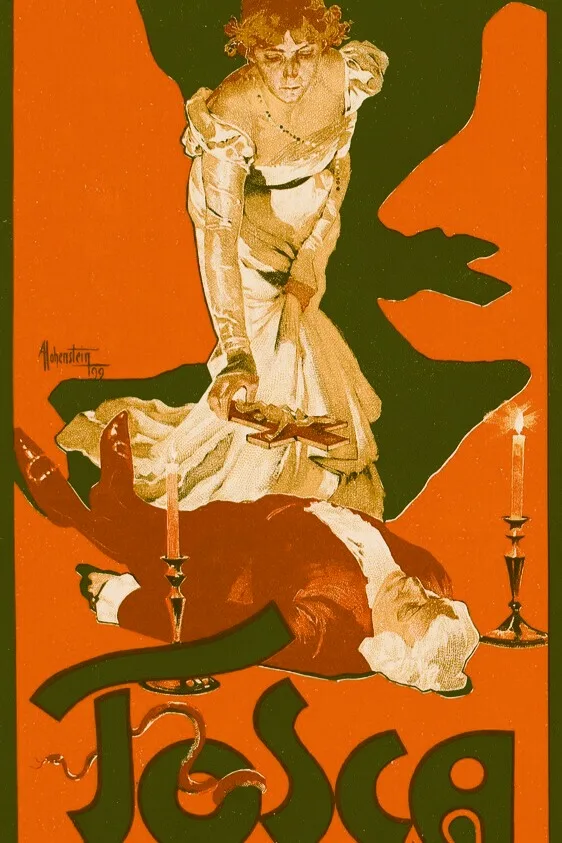
The painter and republican Cavaradossi shelters an escaped political prisoner. The unscrupulous police chief Scarpia desires the celebrated singer Floria Tosca, Cavaradossi's lover, and uses his arrest and torture as leverage. Scarpia promises Tosca her lover's freedom in exchange for her submission and orders what he claims will be a mock execution. Tosca feigns agreement but stabs Scarpia with a table knife once he has written the safe-conduct. Yet the execution at Castel Sant'Angelo is no pretence—Cavaradossi is truly shot. When Scarpia's murder is discovered, Tosca throws herself from the parapet to her death.
Cultural significance
Tosca ranks among the most frequently performed operas worldwide and is a masterpiece of dramatic concentration, containing three of the repertoire's most celebrated arias: Tosca's Vissi d'arte, Cavaradossi's E lucevan le stelle, and Recondita armonia. The role of Tosca demands a singing actress of great stage presence; Scarpia is considered one of opera's most effective villains. Maria Callas's interpretation, especially in the legendary 1964 Zeffirelli production in London, lastingly shaped the modern image of the work.