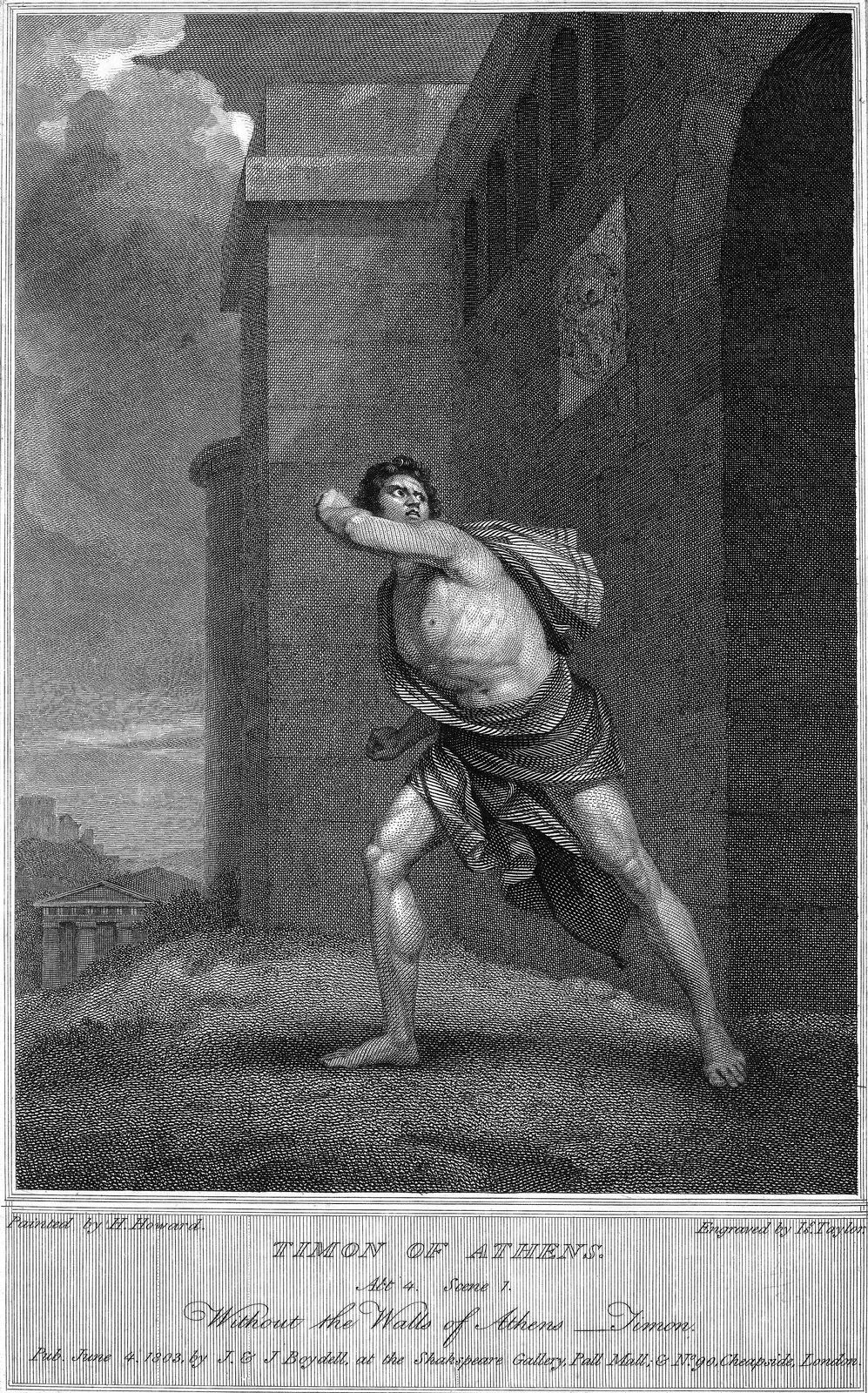
About the work
"Timon of Athens" was likely written around 1605/1606 as a collaboration between Shakespeare and Thomas Middleton, who current scholarship credits with roughly a third of the text. No performance during Shakespeare's lifetime is documented; the play was only added as a late addition to the First Folio of 1623. It is thought to be a text the authors never fully revised.
Plot
The wealthy Athenian Timon squanders his fortune on flatterers and supposed friends until he is deeply in debt. When he asks for help in his hour of need, all his former guests turn away from him. Embittered, Timon withdraws from the city to a cave, where he happens to find a hoard of gold, but uses it only to confirm his misanthropy and curse Athens before dying alone.
Cultural significance
Because of its unusual structure and seemingly unfinished state, the play is one of Shakespeare's least performed and least studied works, though it is occasionally rediscovered precisely for its unsparing social criticism.