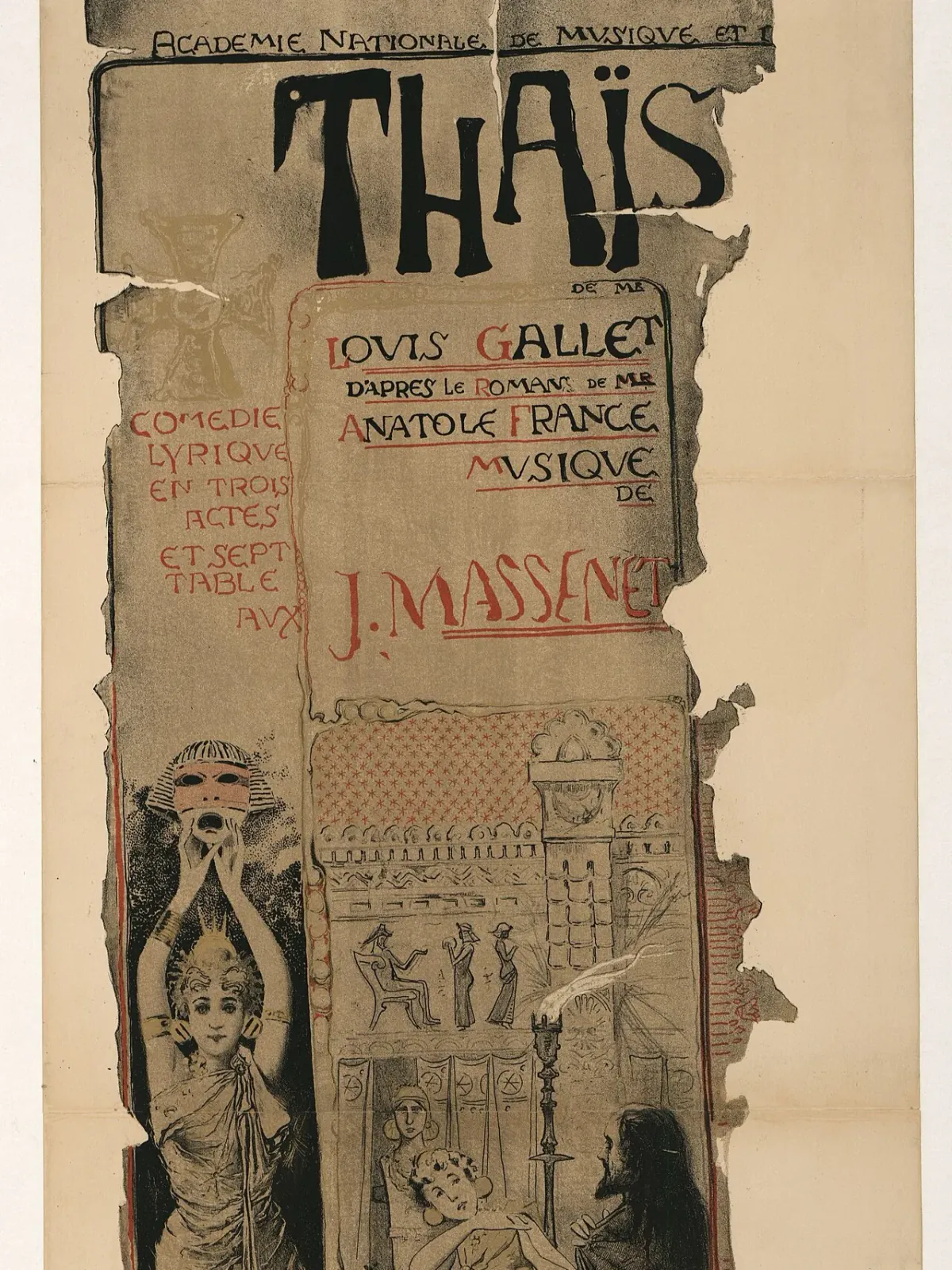
About the work
Jules Massenet's „Thaïs" was premiered at the Paris Opéra in 1894. Louis Gallet's libretto is based on Anatole France's novel of the same name (1890). The opera depicts a biblical-allegorical story from early Christian Alexandria — and contains Massenet's most famous solo piece, the „Méditation" for solo violin.
Plot
In the fourth century AD in Alexandria. Athanaël, a young monk of the desert monastery, comes to Alexandria to save the famous courtesan Thaïs. Thaïs is the lover of Nicias, a wealthy hedonist. Athanaël had known Thaïs in his youth and is secretly still in love with her — which he refuses to admit. At a banquet by torchlight he meets her again; she at first hears his sermon mockingly, then thoughtfully. Alone in her room she is touched by a stirring of religious longing — the Méditation (entr'acte, orchestra with solo violin, one of Massenet's most famous melodies) marks her conversion. She burns her jewels and dresses and follows Athanaël to the desert convent of Saint Albine. The long desert journey leaves her gravely exhausted. In the convent she dies, transfigured in faith — but Athanaël, overwhelmed by his suppressed feelings, arrives too late and confesses his love. Too late: Thaïs dies with a vision of heaven; Athanaël breaks down.
Cultural significance
Thaïs is Massenet's philosophically richest opera. The „Méditation" for solo violin from the second act is one of the most-played concert and entr'acte pieces in the world — a solo (about five minutes long) corresponding to the heroine's entry into the religious sphere. Famous Thaïs interpreters: Mary Garden (for whom the role was written), Beverly Sills, Renée Fleming. The fusion of erotic sensuality (Thaïs as courtesan) with religious redemption is Massenet's own speciality. Recordings under Lorin Maazel, John Eliot Gardiner and Yves Abel are standard.