About the work
Molière's comedy „Tartuffe ou L'Imposteur" was premiered in 1664 at Versailles. The first version was banned for five years on intervention by the Compagnie du Saint-Sacrement. Only in 1669, after several revisions, did the play reach the public stage. It is one of the most-performed comedies in the French repertoire.
Plot
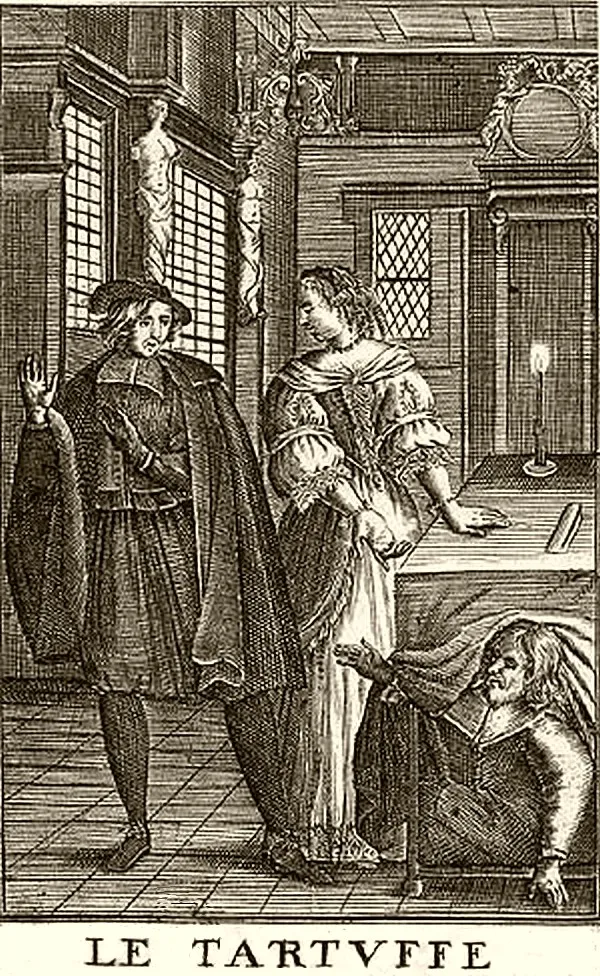
Paris in the 1660s. The wealthy bourgeois Orgon has fallen under the spell of Tartuffe, a religious hypocrite who poses as a saint. Orgon takes him into the house, ignores his family — wife Elmire, daughter Mariane, son Damis, brother-in-law Cléante, all of whom see through Tartuffe — and intends to marry his daughter to Tartuffe. Elmire arranges a trap: she lets Tartuffe make passionate advances to her while Orgon hides under a table. Tartuffe is exposed. But Orgon has already deeded his property to Tartuffe and given him compromising documents. Tartuffe seizes his chance, has Orgon evicted from his own house, and tries to have him arrested for treason. In a deus-ex-machina ending the king's officer arrives — but to arrest Tartuffe, whose past as a swindler is well known to the king. Orgon is rehabilitated; Mariane marries her lover Valère.
Cultural significance
Tartuffe is the prototype of the religious-hypocrite play. „Tartuffe" has become a French synonym for sanctimony. The play has been performed continuously since the seventeenth century at the Comédie-Française and worldwide. Productions by Roger Planchon, Ariane Mnouchkine, Stéphane Braunschweig and Christoph Marthaler have given the work modern readings. The play has lost none of its political force — in countries with strong religious institutions it remains a sensitive text.