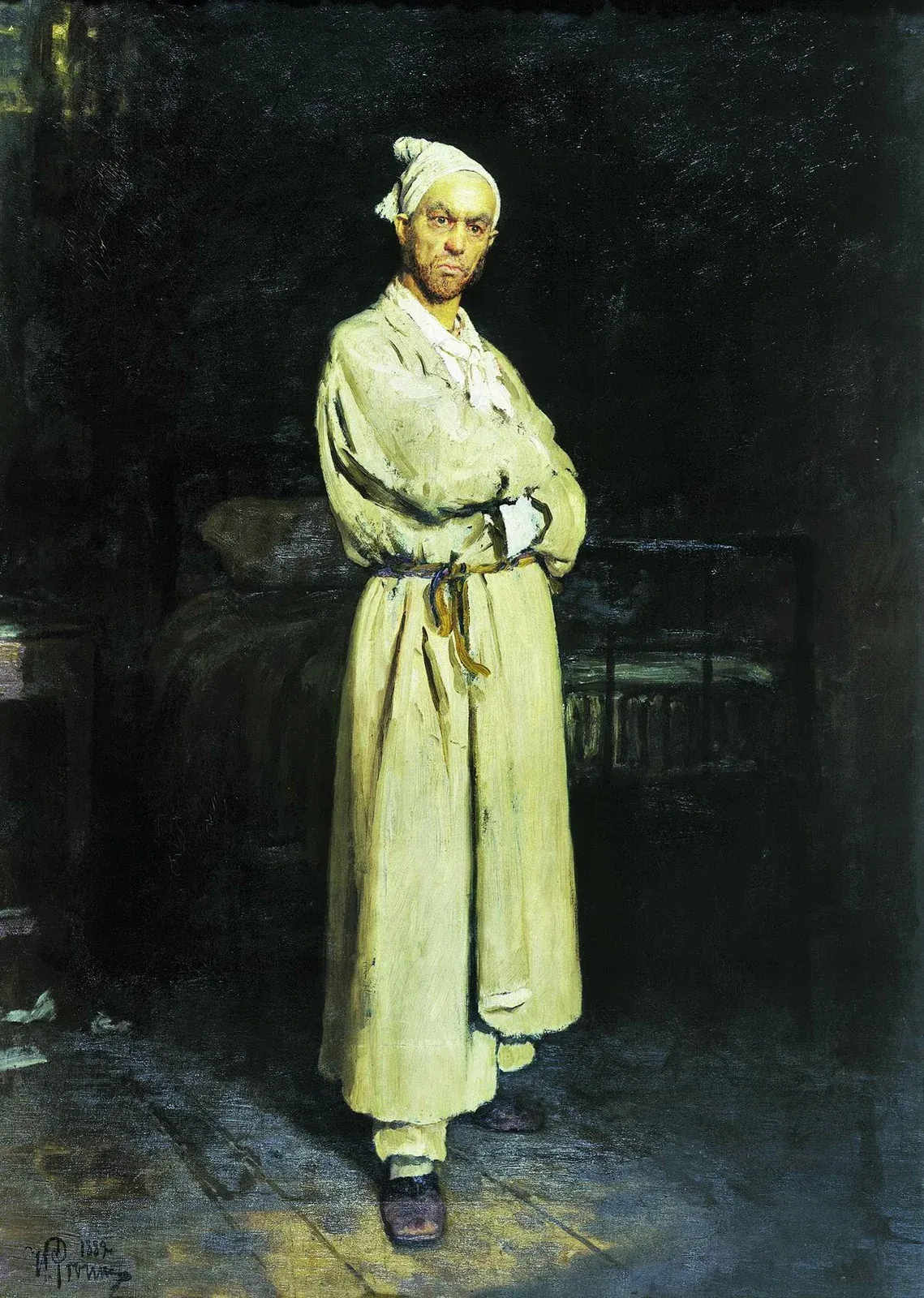
About the work
“Tagebuch eines Wahnsinnigen” is a German title, also used on stage, of Nikolai Gogol's short story “Diary of a Madman” (Russian “Записки сумасшедшего”, in German also “Aufzeichnungen eines Wahnsinnigen”). Gogol wrote it between August and October 1834 and published it in January 1835 in the collection “Arabesques”. It is the only one of his works told entirely in the first person and consists of dated diary entries. In German it is available among others in Kay Borowsky's translation, published in 1995 under the title “Tagebuch eines Wahnsinnigen”.
Plot
Aksenty Poprishchin, a titular councillor in a Saint Petersburg government office, mends the director's pens and falls hopelessly in love with the director's daughter Sophie. He believes he hears two dogs talking, steals their letters and reads that Sophie finds him ridiculous and is going to marry someone else. When he reads in the newspaper about the unresolved succession to the Spanish throne, he declares himself King Ferdinand VIII, while the dates of his entries become increasingly absurd. He finally ends up in an asylum, which he takes first for the Spanish court and then for the Inquisition, and in the end he cries out for his mother.
Cultural significance
Together with “The Nose” and “The Overcoat”, the story is among Gogol's best-known prose works; Vissarion Belinsky already praised the way it combines comedy and compassion. Nineteenth-century physicians read it as an accurate account of progressing delusion, and in 2001 the psychiatrist Eric Lewin Altschuler called Poprishchin one of the earliest detailed portrayals of schizophrenia. The Chinese writer Lu Xun took up the title in 1918 for his story “A Madman's Diary”, and stage versions such as David Holman's play, performed in Sydney in 2010 with Geoffrey Rush, keep the material alive in the theatre.