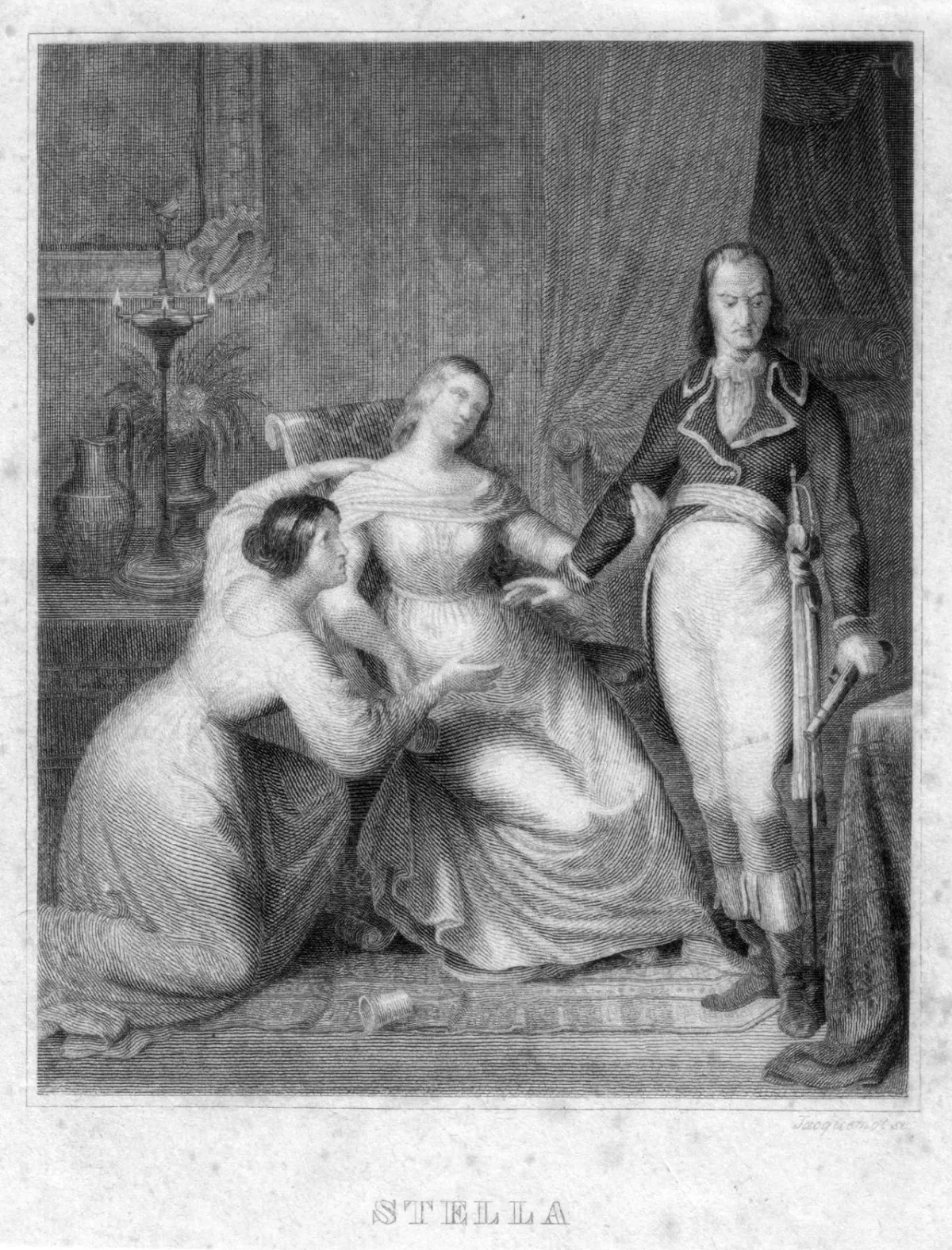
About the work
Johann Wolfgang von Goethe's five-act play was premiered in 1776 as A Play for Lovers with a triangular-harmony ending that scandalised contemporary critics because of its unveiled bigamy. Goethe revised the work in 1806 into a tragedy with a devastating conclusion. The play belongs to Goethe's late Sturm und Drang phase and treats emotional entanglement between two women with a directness that only the twentieth century would fully appreciate.
Plot
The officer Fernando lives with Stella, a young woman who experiences him as her husband. A stranger named Cäcilia arrives with her daughter Lucie — she is Fernando's earlier wife, whom he had abandoned. The two women recognise their shared entanglement and, paradoxically, love each other. In the 1776 version, the three agree to live together; in the 1806 revision, Stella poisons herself, Fernando shoots himself, and Cäcilia is left alone.
Cultural significance
Stella is a radical document of its time — the original version with its bigamous harmony ending broke moral conventions and cemented Goethe's reputation as a literary revolutionary. The later revision defused the scandal but turned the play into more conventional tragedy. Productions in recent decades, including Stephan Kimmig at the Thalia Theater Hamburg, have played both versions in parallel or on double bills, making visible the productivity of Goethe's moral experiment.