About the work
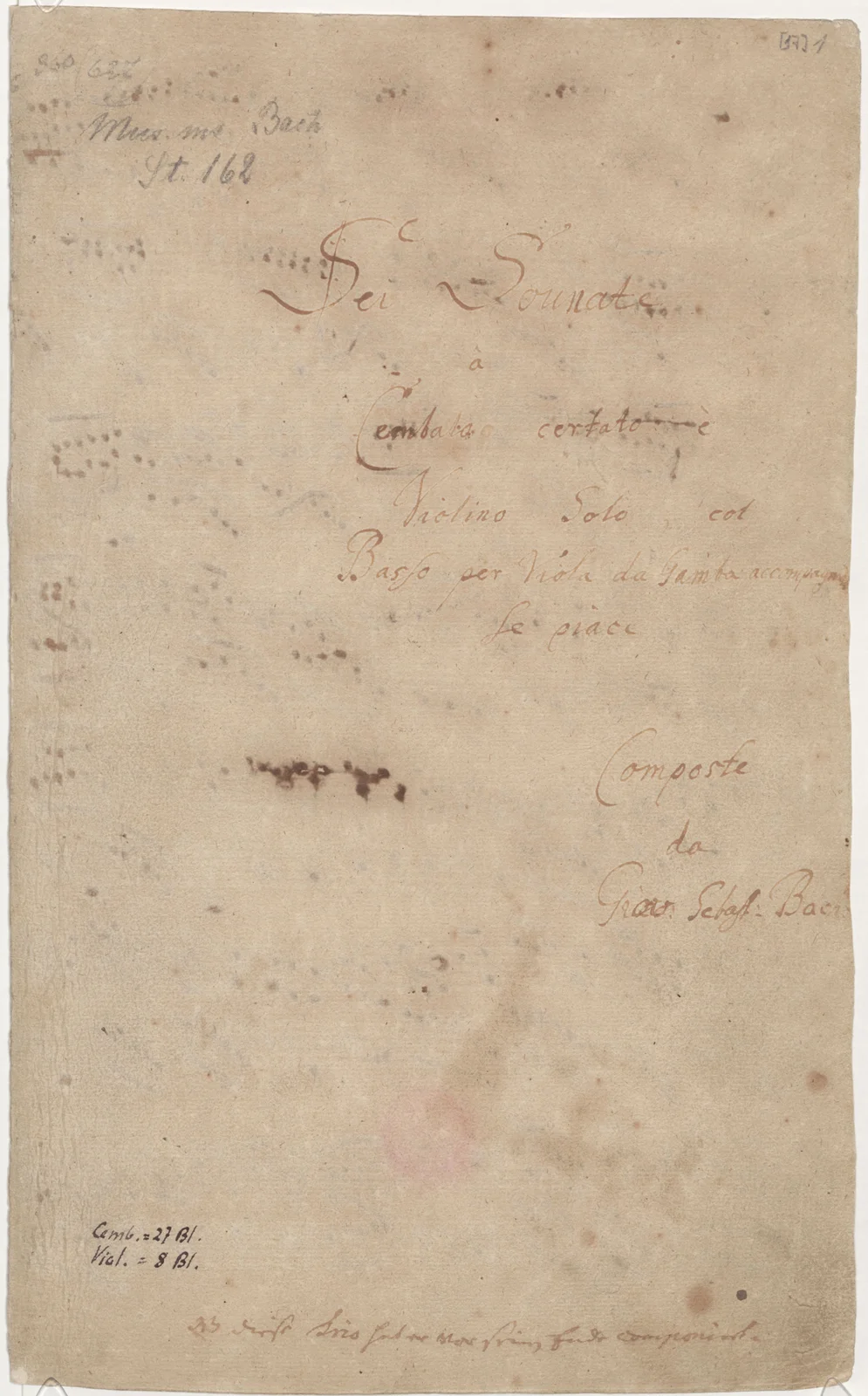
The Sonata in G major, BWV 1019, is the sixth and last of Johann Sebastian Bach's six sonatas for violin and obbligato harpsichord — and at the same time the most unusual. It survives in several markedly differing versions; in its final form it comprises five movements, thus breaking the four-movement church-sonata scheme of the other five works. Its centrepiece is a movement for harpsichord alone, in which the keyboard steps entirely out of its accompanying role. Like the whole cycle, the work probably originated in Bach's Cöthen years and was reworked several times into his Leipzig period.
Plot
The sonata opens with a festive, concerto-like Allegro in radiant G major. A lyrical Largo follows before the centre of the sonata is reached: a virtuoso movement for harpsichord alone, in which the violin falls silent and the keyboard fully unfolds its independence. An intimate Adagio then follows, in which violin and harpsichord come together again. The close is a buoyant Allegro that rounds off the sonata — and with it the whole cycle — with cheerful brilliance.
Cultural significance
With its five-movement layout and interpolated harpsichord solo, BWV 1019 occupies a special place not only within the cycle but in Bach's chamber music as a whole. The several surviving versions show how intensively Bach worked on this piece, exchanging individual movements. As the keystone of the collection BWV 1014–1019, which C. P. E. Bach counted among his father's finest works, the G major sonata crowns one of the most important chamber-music cycles of the Baroque.