About the work
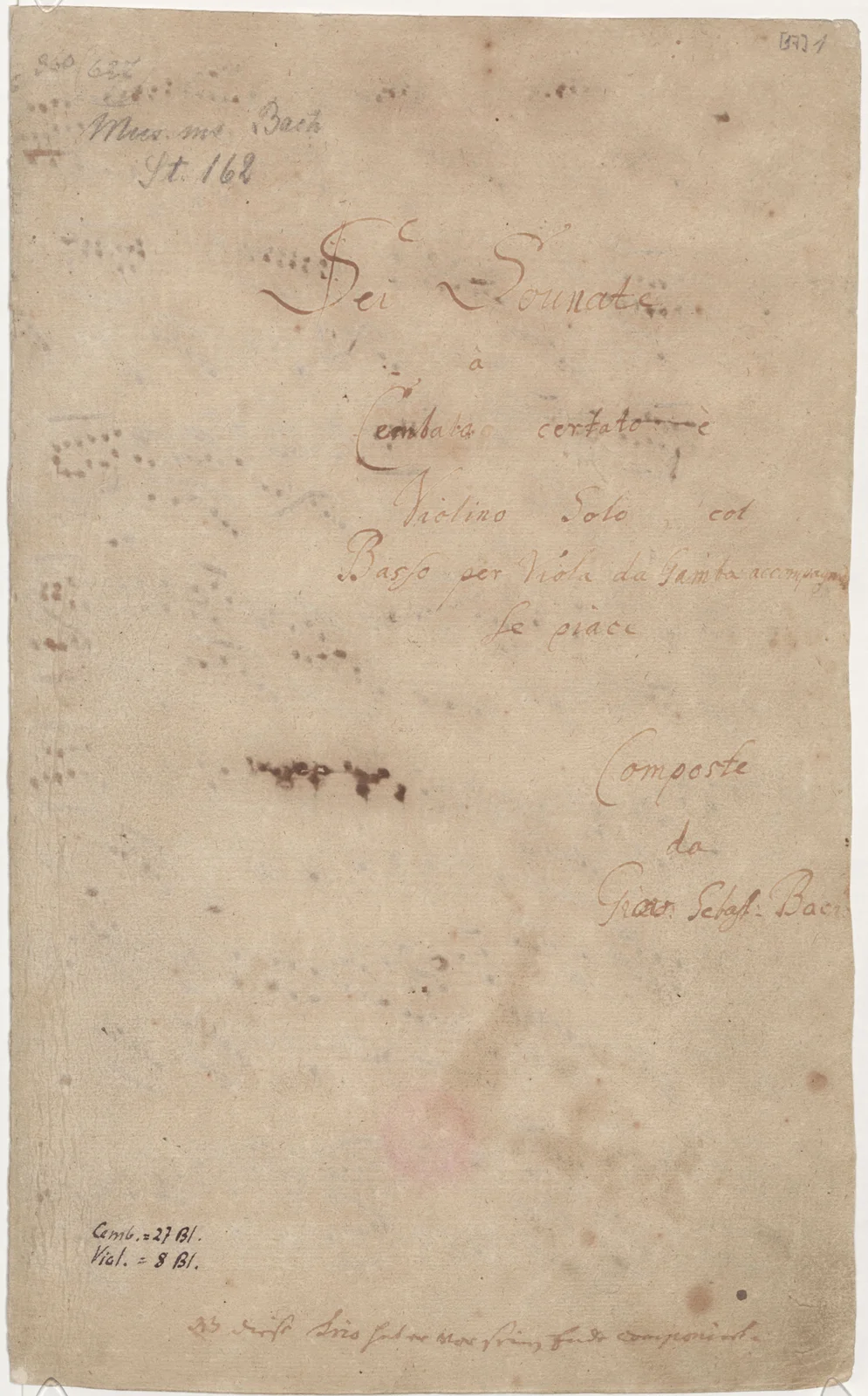
The Sonata in E major, BWV 1016, is the third of Johann Sebastian Bach's six sonatas for violin and obbligato harpsichord. It too is written as a three-part trio sonata, in which the violin and the harpsichord's right hand act as equal melodic partners over an independent bass. With its radiant key and its expansive, artful central movement, it ranks among the most impressive of the cycle. Like its companions it probably originated in Bach's Cöthen period between 1717 and 1723 and was further revised in Leipzig; the four-movement layout follows the slow–fast–slow–fast scheme of the church sonata.
Plot
The opening Adagio spreads a richly ornamented, songful violin line over a flowing harpsichord bass. The ensuing Allegro interlocks the three voices in lively fugal play. The high point is the third movement, an Adagio ma non tanto, which unfolds one of Bach's most moving slow inspirations over a persistently recurring bass pattern — a kind of ostinato or passacaglia. The closing Allegro takes up the three-part counterpoint again and rounds off the sonata with festive brilliance.
Cultural significance
The ostinato Adagio of BWV 1016 is among the most admired slow movements in Baroque chamber music, showing Bach's art of building music that is at once strict and deeply felt over a simple harmonic framework. Within the collection BWV 1014–1019, which C. P. E. Bach counted among his father's finest works, the E major sonata holds an outstanding place. It has remained a fixture of the concert repertoire for violin and keyboard instrument.