About the work
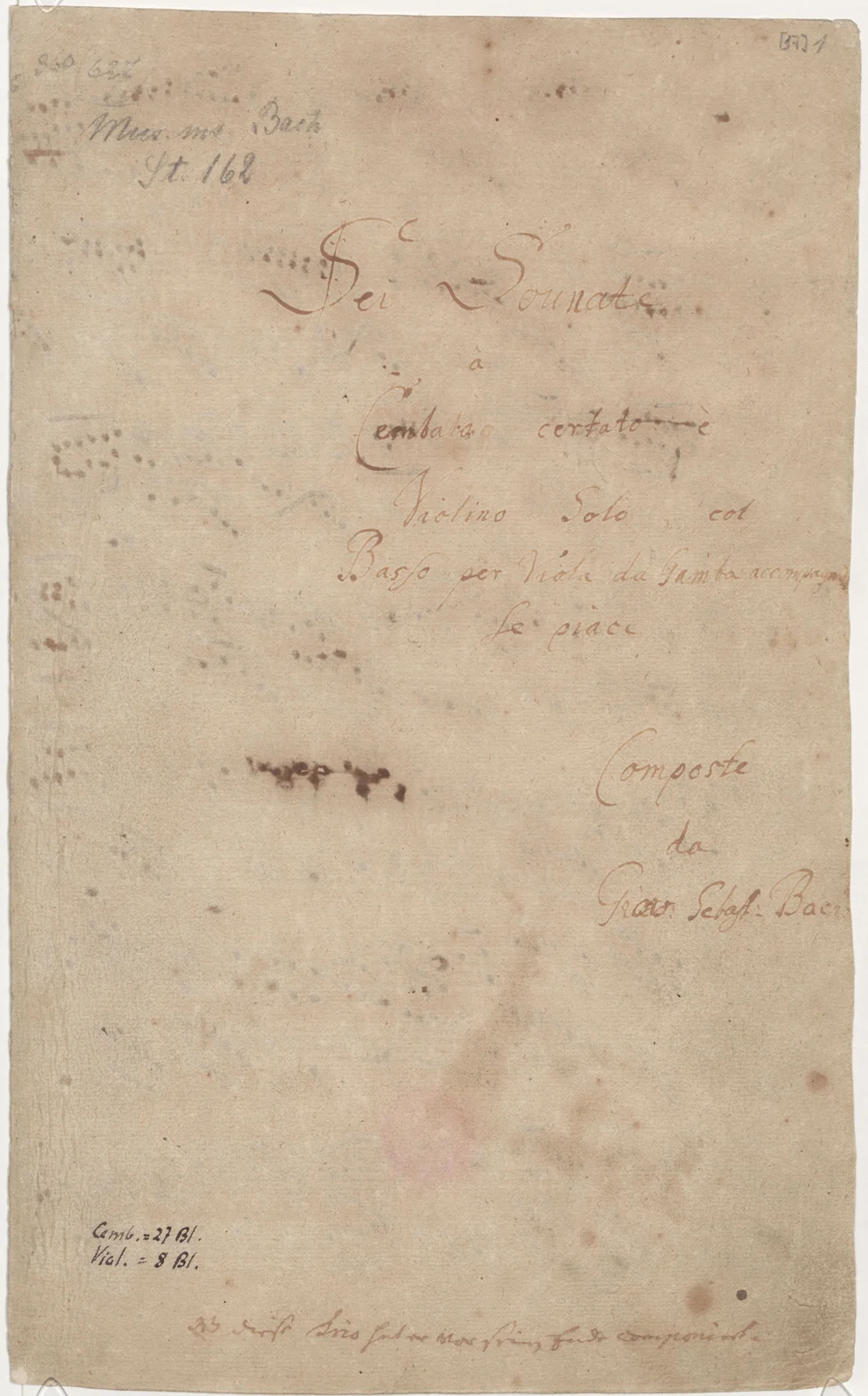
The Sonata in C minor, BWV 1017, is the fourth of Johann Sebastian Bach's six sonatas for violin and obbligato harpsichord. Like the whole cycle it is written as a three-part trio sonata, in which the violin and the written-out right hand of the harpsichord play as equal upper voices over an independent bass. The sonata follows the four-movement model of the Italian church sonata (slow–fast–slow–fast). Most famous is its opening movement, a Siciliano whose mournfully swaying violin melody over the harpsichord's broken chords ranks among Bach's best-known inspirations. The work probably originated in Bach's Cöthen years and was further revised in Leipzig.
Plot
The opening Siciliano (Largo) lets the violin spread a broadly arched, plaintive cantilena over the arpeggiated harpsichord — one of Bach's most famous slow melodies. A serious, extended Allegro in strict fugal writing follows. The third movement, an Adagio in the relative major, gives the violin a second songful line and, as a calm interlude, prepares the finale. The close is an energetic Allegro in 2/4, again fugal, drawing the three voices together in lively counterpoint.
Cultural significance
The Siciliano from BWV 1017 became known far beyond chamber music and has been played in countless arrangements. It exemplifies Bach's art of building a deeply felt melody over a simple harmonic framework. Within the collection BWV 1014–1019, which C. P. E. Bach counted among his father's finest works, the C minor sonata is among the most expressive and has remained a fixture of the concert repertoire for violin and keyboard instrument.