About the work
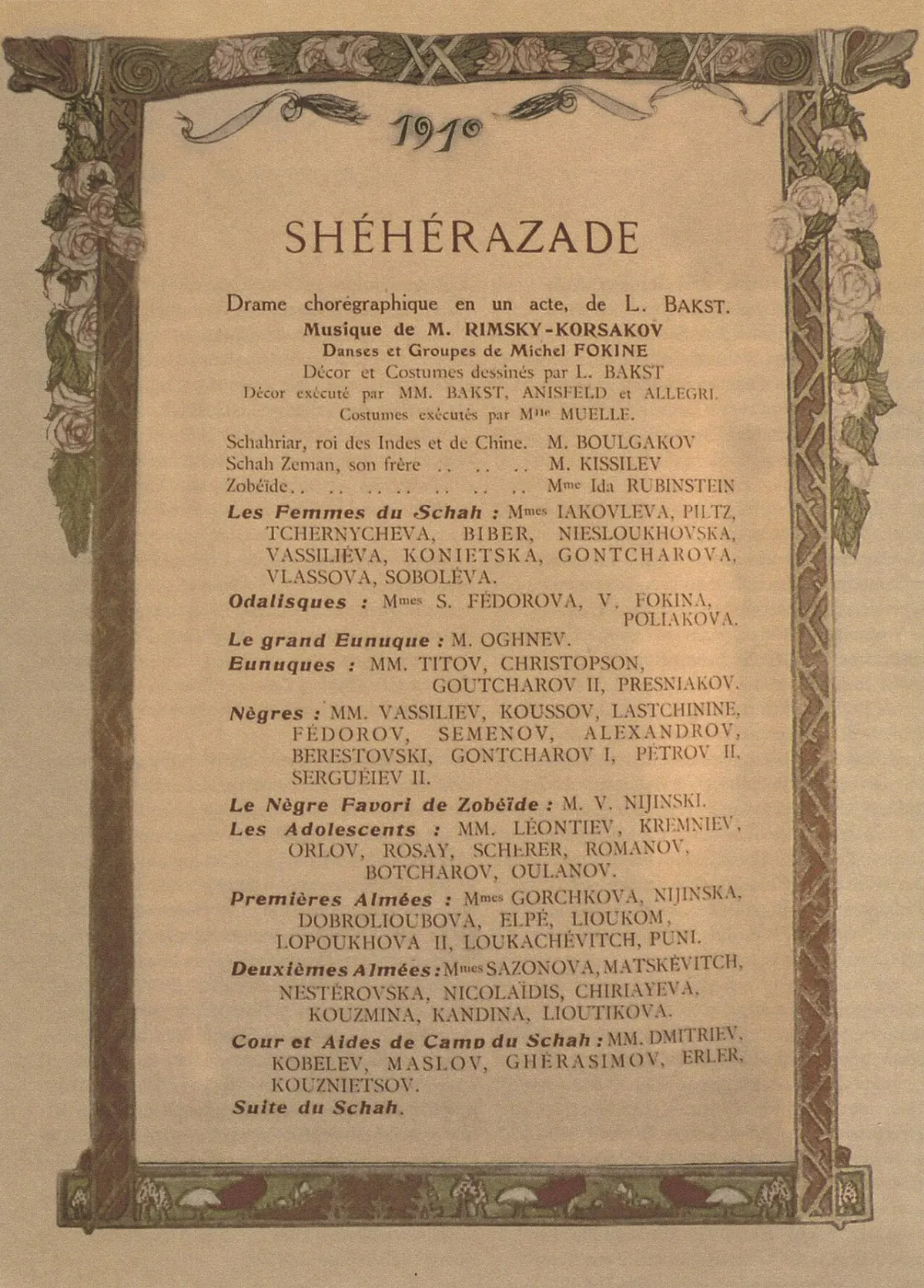
Scheherazade is a narrative ballet to the symphonic suite of the same name by Nikolai Rimsky-Korsakov, made famous in Michel Fokine's choreography for the Ballets Russes, premiered in Paris in 1910. The music itself dates from 1888. With Léon Bakst's legendary designs, it became the epitome of the exotic Orientalism of the Ballets Russes.
Plot
In the harem of Sultan Shahryar, the suspicious ruler feigns his departure for the hunt to test the fidelity of his wives. No sooner is he gone than the harem women bribe the guards and bring in their lovers; foremost the favourite wife Zobeide with the "Golden Slave." In an intoxicating orgy of dance and sensuality they celebrate their forbidden desire. But the Sultan returns unexpectedly and has all the lovers and unfaithful wives slaughtered; Zobeide takes her own life.
Cultural significance
Scheherazade was one of the greatest triumphs of the Ballets Russes and set off a veritable fashion for Oriental aesthetics in art, fashion, and design across Europe. Its uninhibited sensuality and Vaslav Nijinsky's legendary portrayal of the Golden Slave caused a sensation. Despite the loose relationship to Rimsky-Korsakov's actual suite, the ballet became a symbol of the revolutionary fusion of music, dance, and visual art for which Diaghilev's company stood.