About the work
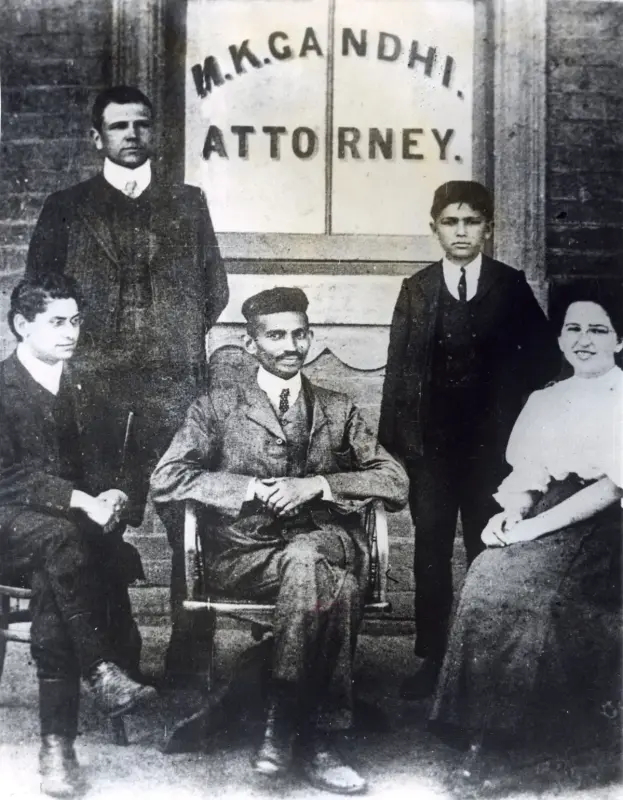
Philip Glass's „Satyagraha" was premiered in Rotterdam in 1980 and is the second part of his „portrait trilogy" (after „Einstein on the Beach", before „Akhnaten"). The opera depicts the early years of Mahatma Gandhi in South Africa and the birth of the movement of nonviolent resistance. The libretto is in Sanskrit, drawn from the „Bhagavad Gita".
Plot
„Satyagraha" — Sanskrit for „holding firmly to truth" — tells its story not linearly but in solemn tableaux. At its centre stands Gandhi's time in South Africa between 1893 and 1914, in which, as a young lawyer, he fights the disenfranchisement of the Indian minority and develops the method of nonviolent resistance: the founding of the Tolstoy Farm commune, the burning of the passes, the great protest march. Over each of the three acts watches, silent and exalted, a historical figure — Leo Tolstoy (the past), the poet Rabindranath Tagore (the present) and Martin Luther King (the future) — who carries Gandhi's idea before and beyond him. The Sanskrit verses of the Gita lie over the action as a timeless reflection.
Cultural significance
„Satyagraha" is regarded as a key work of minimalist opera and Glass's most accessible stage work. The combination of repetitive, slowly shifting music, meditative images and the theme of nonviolent resistance made the work a worldwide success; Phelim McDermott's production for English National Opera and the Metropolitan Opera became especially famous.