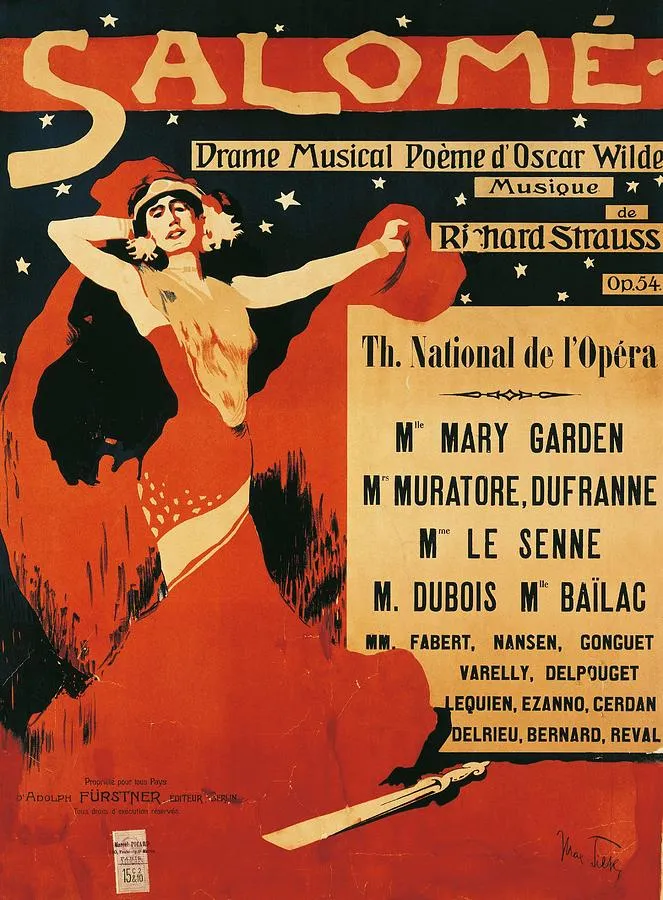
About the work
Richard Strauss's one-act opera, a nearly verbatim setting of Oscar Wilde's French-language play in Hedwig Lachmann's German translation, was premiered on 9 December 1905 at the Königliches Opernhaus Dresden. The work scandalised audiences with its lurid subject and revolutionary harmonic language; the Vienna Court Opera and the Metropolitan Opera both suppressed it after early performances, and it remains among the most concentrated dramatic experiences in the repertoire.
Plot
At King Herod's court in biblical Judea, the young princess Salome becomes obsessed with Jokanaan (John the Baptist), the prophet imprisoned in a cistern beneath the palace. When he rejects her advances and curses her, she demands his execution as the price for dancing for her lustful stepfather Herod. After performing the Dance of the Seven Veils, she receives Jokanaan's severed head on a silver platter and kisses the dead lips in an extended monologue of horror and rapture. Herod, revolted by the spectacle he has enabled, orders his soldiers to crush her beneath their shields.
Cultural significance
Salome transformed operatic possibility at a stroke. Strauss's harmonic language, with dissonances that shocked 1905 audiences, opened the territory Berg and Schoenberg would soon inhabit; Gustav Mahler called it the most epoch-making composition since Wagner. The title role demands a soprano with dramatic weight, lyrical flexibility, and the physical stamina to dance—a combination so rare that the part has been associated with figures from Ljuba Welitsch through Birgit Nilsson and Hildegard Behrens to Nina Stemme. Many productions substitute a dancer for the Dance of the Seven Veils, an option Strauss's score explicitly permits.