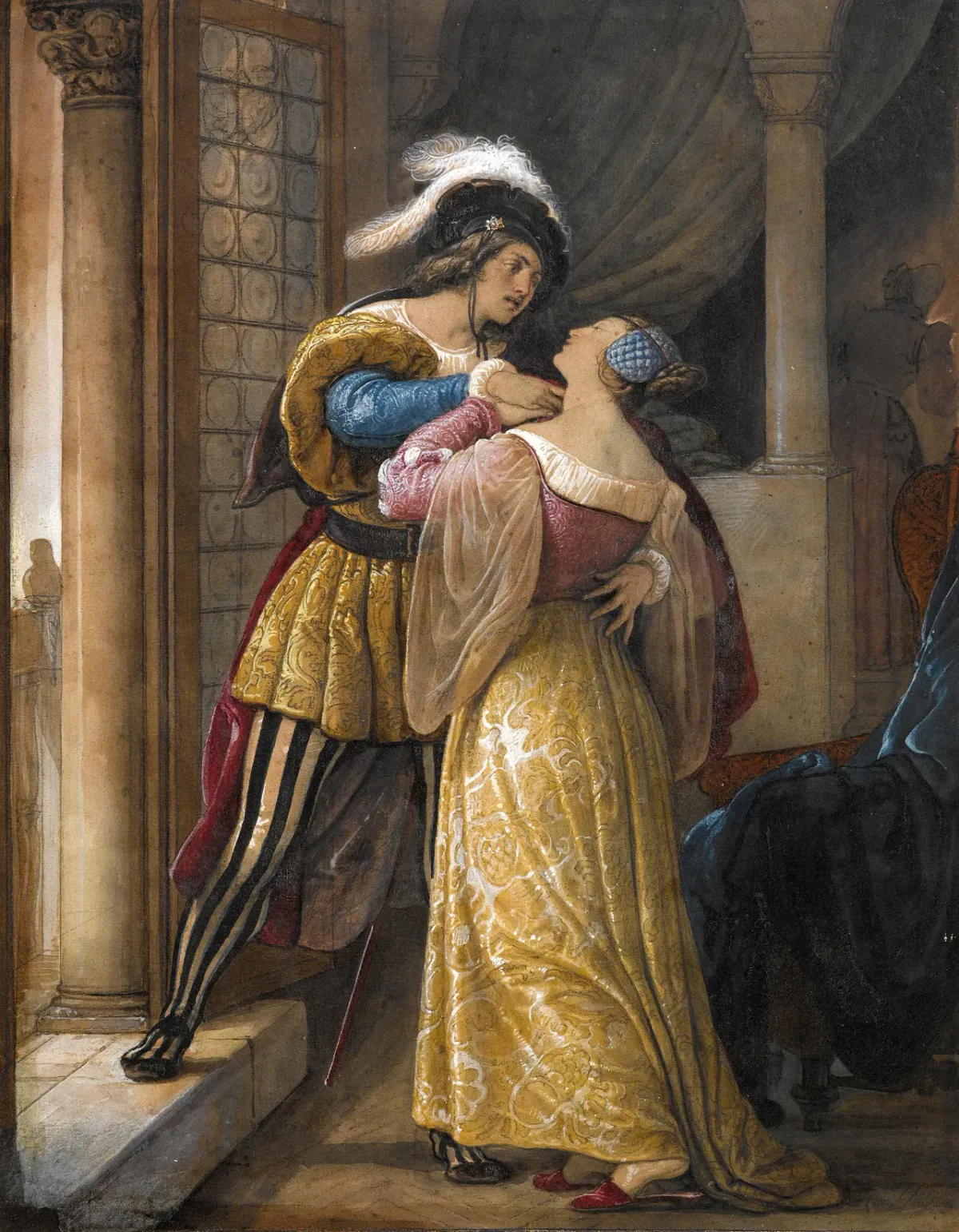
About the work
Romeo and Juliet is a tragedy by William Shakespeare, written around 1595, perhaps the most famous love story in world literature. The play combines lyrical artistry—the lovers' first exchange takes the form of a shared sonnet—with bawdy comedy and headlong dramatic acceleration; the entire action unfolds over just a few days. Shakespeare followed an English verse narrative by Arthur Brooke, itself based on an Italian source.
Plot
In Verona a bitter feud rages between the Montague and Capulet families. Romeo Montague and Juliet Capulet fall in love at a masked ball and are secretly married by Friar Laurence, who hopes to reconcile the houses. When Romeo kills Juliet's cousin Tybalt in a street fight—after Tybalt has slain his friend Mercutio—he is banished from Verona. Juliet, ordered to marry Count Paris against her will, takes a sleeping potion that makes her appear dead. The message fails to reach Romeo; believing her dead, he hurries to the tomb and takes poison. Juliet wakes, finds Romeo dead, and stabs herself. Only the death of the lovers reconciles the feuding families.
Cultural significance
Romeo and Juliet is the archetype of the tragic love story and has permeated Western culture like scarcely any other literary work. The drama inspired countless adaptations in music, dance, film, and visual art—from Berlioz's dramatic symphony through Gounod's opera and Prokofiev's ballet to West Side Story and Baz Luhrmann's 1996 film. The balcony scene and Mercutio's Queen Mab speech are among the most quoted passages in theatrical history; the play is among the most frequently performed of all Shakespeare's works worldwide.