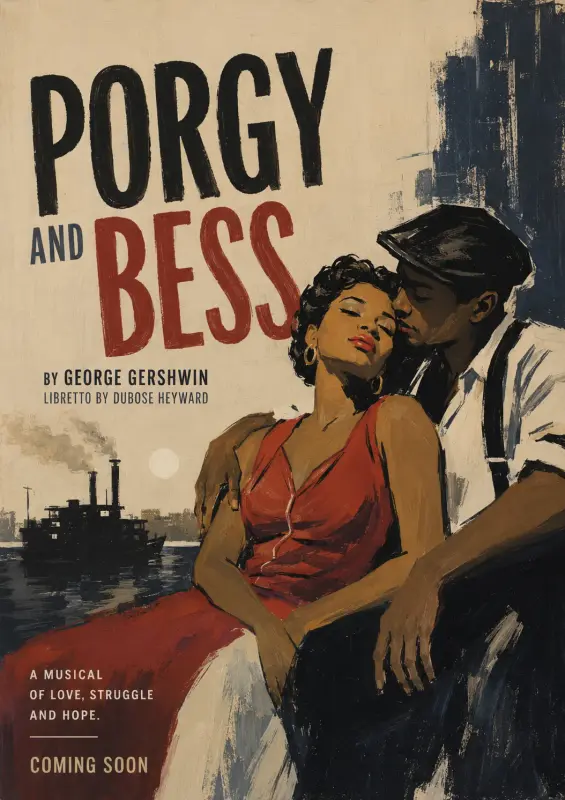
About the work
George Gershwin's opera „Porgy and Bess" was premiered in Boston/Manhattan in 1935 and is the most important American opera of the twentieth century. The libretto is by DuBose Heyward and Ira Gershwin after Heyward's novel „Porgy" (1925). Gershwin explicitly demanded that the leading parts be sung by African-American singers — a then-revolutionary requirement.
Plot
In „Catfish Row", a Black neighbourhood in Charleston, South Carolina in the 1920s. The piece opens with Clara's lullaby „Summertime". Porgy, a crippled beggar who gets about on a goat cart, loves the beautiful Bess, considered a drug addict and prostitute. Bess comes to Porgy as her protector after her brutal lover Crown stabs the regular Robbins in a craps fight and has to flee. At a picnic on Kittiwah Island, Bess meets Crown again; he takes her sexually. She returns feverish to Porgy. Bess finds peace with Porgy in one of opera's most famous love duets („Bess, you is my woman now"). Crown returns to take Bess back — Porgy kills him in a fight. The police arrest Porgy as a witness; while he is away, the drug dealer Sportin' Life lures Bess away with „happy dust" and the promise of New York. Porgy returns to find Bess gone. He asks his way around — and decides to follow her to New York in his goat cart: „I'm on my way!"
Cultural significance
Porgy and Bess is the supreme American opera and contains in „Summertime", „It Ain't Necessarily So", „I Got Plenty o' Nuttin'" and „Bess, You Is My Woman Now" some of the most popular songs in American musical history — many became jazz standards. Long contested — Gershwin as a white composer painting Black characters — the opera has in recent decades been reread through African-American productions (Trevor Nunn 2006, Met 2019). The Glyndebourne Festival in 1986 with Simon Rattle established an early „European" standard performance.