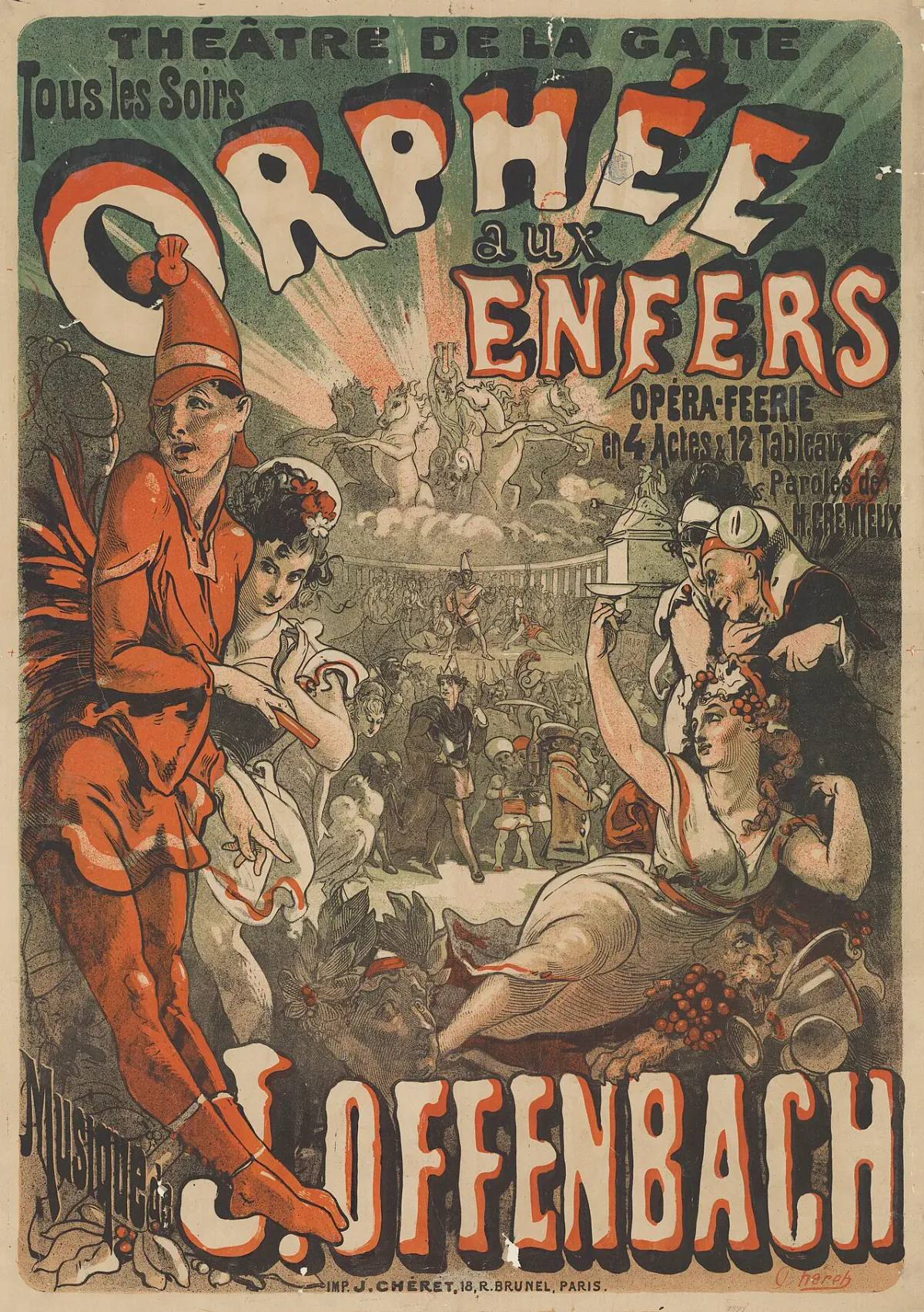
About the work
Orpheus in the Underworld is an operetta (opéra-bouffon) by Jacques Offenbach, premiered in Paris in 1858. It is regarded as one of the first full-length operettas and a founding work of the genre. The libretto by Hector Crémieux and Ludovic Halévy irreverently parodies the ancient Orpheus myth and the bourgeois society of the Second Empire.
Plot
Unlike in the classical myth, Orpheus and Eurydice are a quarrelling couple thoroughly tired of each other. When Eurydice is abducted to the underworld by Pluto, Orpheus is greatly relieved—only the personified "Public Opinion" forces him to retrieve her. On Olympus, meanwhile, the gods are bored and rebel against Jupiter's rule. A turbulent journey into the underworld culminates in the famous "Infernal Galop," the can-can, while Eurydice in the end prefers to stay with the gods.
Cultural significance
Orpheus in the Underworld launched the worldwide success of Offenbachian operetta and contains, in the Galop infernal, perhaps the most famous can-can melody in music history. The cheeky parody of myth and society, holding gods and dignitaries up to ridicule, struck the nerve of its time and at times caused outrage. The work remains part of the core repertoire and symbolises the spirit of French operetta.