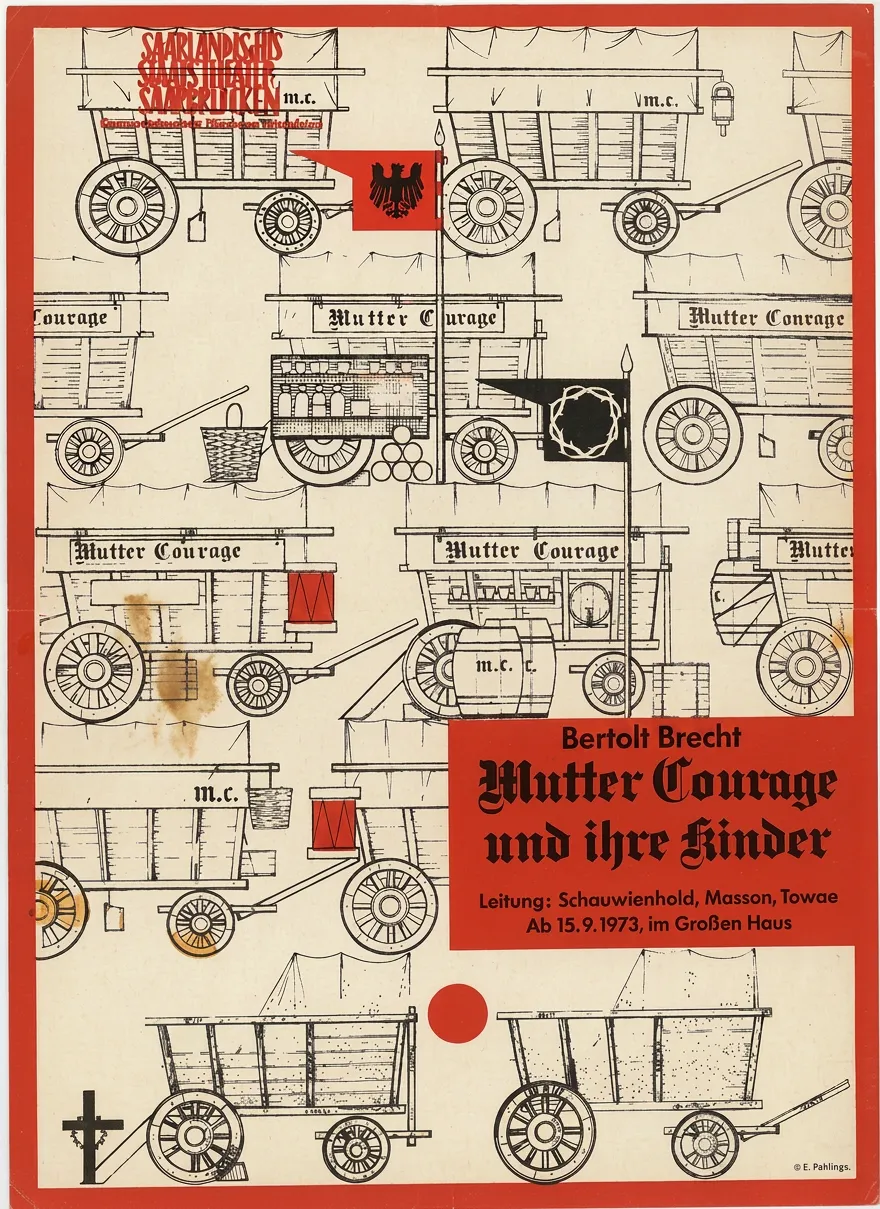
About the work
Bertolt Brecht's „Mother Courage and Her Children" was written in Swedish exile in 1939 and premiered in Zurich in 1941. The play is regarded as the most important anti-war drama of the twentieth century. Brecht set the action in the Thirty Years' War as an allegory of the looming Second World War.
Plot
Sweden, 1624. The canteen-woman Anna Fierling, known as „Mother Courage", travels with her covered wagon and her three children Eilif, Swiss Cheese and the mute Kattrin across the battlefields of central Europe. She hopes to make her business out of the war — and to survive it through business. Eilif, the brave son, is recruited by the Swedish recruiting officer and lured into a heroic deed; later, in peacetime, he is executed for that very deed. Swiss Cheese, the honest son, becomes paymaster of the Swedish regiment; when the imperial troops overrun the camp, Mother Courage tries to save the regimental cashbox and haggles too long — Swiss Cheese is shot. Mother Courage must deny his corpse, so that she will not be recognised as his mother. Finally the mute Kattrin, during the assault on Halle, drums from the roof of a farmhouse to warn the town — and is shot. Mother Courage walks on alone with her empty wagon, singing: „Spring is coming, wake up, Christian! / The snow melts away, the dead remain."
Cultural significance
Mother Courage is Brecht's most famous play and a key work of epic theatre. Helene Weigel — Brecht's wife — shaped the role so strongly that she is regarded as the embodiment of Courage. The Berliner Ensemble production of 1949 with Weigel was Brecht's theatrical-historical breakthrough in Germany. Paul Dessau's music shapes the songs. The work is standard repertoire on German and international stages; a famous Public Theater New York production with Meryl Streep in 2006 showed the work's continuing vitality in the twenty-first century.