About the work
Arnold Schoenberg's unfinished opera „Moses und Aron" was premiered in Zurich in 1957, posthumously after Schoenberg's death in 1951. Schoenberg worked on the piece from 1923 to 1932; only the first two of the three planned acts were fully set. The language is Schoenberg's twelve-tone system, the material: the Old Testament drama of Moses, the prophet of the word, and his brother Aaron, the maker of images.
Plot
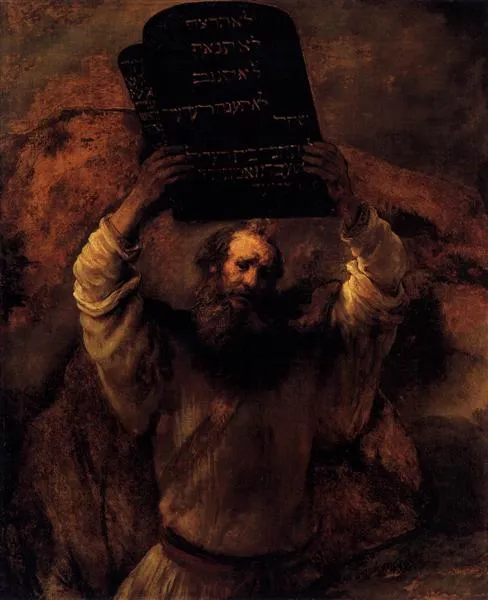
Act I: Moses at the burning bush — God (a four-part Sprechchor with six soloists) commissions him to free the people of Israel from Egypt. Moses confesses that he „is not master of the word" — his idea of God is abstract, unutterable. His elder brother Aaron is assigned to him as his „mouth" — capable of producing images, miracles and speeches. Before the people Aaron demonstrates the idea of God through miracles (staff to serpent, hand to leprosy, water to blood). The people follow. Act II: Moses is absent on Mount Sinai for forty days, the people despair. Aaron has the women's gold cast into the Golden Calf — an orgiastic adoration scene with dance music, sexual ecstasy, four human sacrifices, a self-mutilation dance. Moses returns and destroys the calf. In the ensuing argument Aaron defends the image as necessary — the people need something visible. Moses despairs: „O Wort, du Wort, das mir fehlt!" — and the work breaks off. Act III was to depict Moses's death; it exists only as a text fragment, often added as a spoken epilogue.
Cultural significance
Moses und Aron is Schoenberg's principal work and is considered one of the most significant operas of the twentieth century — despite, or precisely because of, its unfinished state. The opera takes up the Jewish prohibition of images and the unutterable idea of God — themes that became existential for the Jewish Schoenberg after 1933. The orgiastic Golden Calf scene is one of the most ambitious dance-chorus-tableau scenes in all opera. Productions by Pierre Boulez/Patrice Chéreau (Paris Opéra 1973), Hans Neuenfels and Reto Nickler have firmly established the work in the repertoire.