About the work
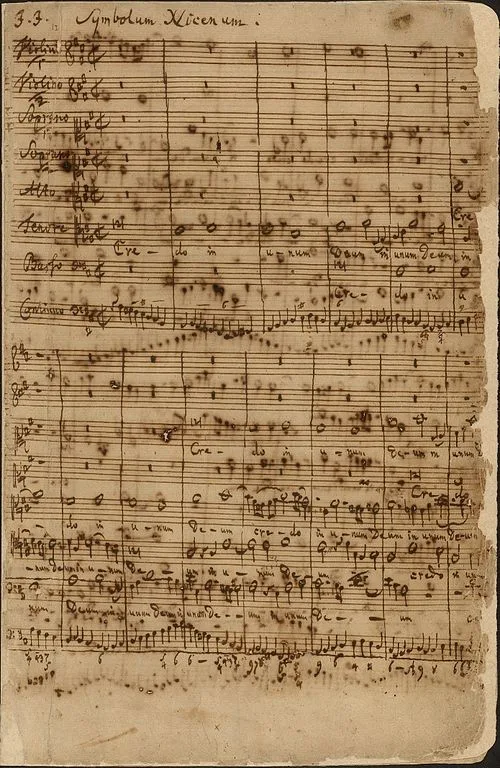
Johann Sebastian Bach's „Mass in B minor" (BWV 232) is Bach's largest vocal composition and his last great completed work. Bach compiled the piece between 1748 and 1749, shortly before his death, by combining older movements (some drawn from cantatas) with newly composed material. A complete performance was never given in Bach's lifetime.
Plot
The work comprises the five parts of the Latin mass ordinary: Kyrie, Gloria, Credo, Sanctus, Agnus Dei. In Bach's division they are organised into 27 movements. Highlights: the opening Kyrie as a solemn fugue on the descending chromatic theme; the jubilant „Gloria in excelsis Deo"; the majestic Sanctus with six-part chorus and long Hosanna fugue; the famous bass aria „Et in Spiritum Sanctum" with oboe d'amore; the soprano-tenor duets „Christe eleison" and „Et in unum Dominum". The Credo contains the musically revolutionary „Crucifixus" — a darkly chromatic descending passacaglia over a bass repeated twelve times — followed by the radiantly bright „Et resurrexit". The closing „Dona nobis pacem" repeats the music of the „Gratias" from the Gloria — an arch spanning the whole work.
Cultural significance
The B Minor Mass is Bach's testamentary work and is considered the greatest mass composition of all time. As a Lutheran composer Bach created here a Catholic mass — probably intended for the Catholic Saxon court in Dresden. The first complete performance was given only in 1859 in Leipzig. Today the work belongs to the most-performed choral classics; recordings under Karl Richter, Otto Klemperer, Nikolaus Harnoncourt, John Eliot Gardiner, Philippe Herreweghe, Masaaki Suzuki are reference performances. Part of UNESCO's musical heritage.