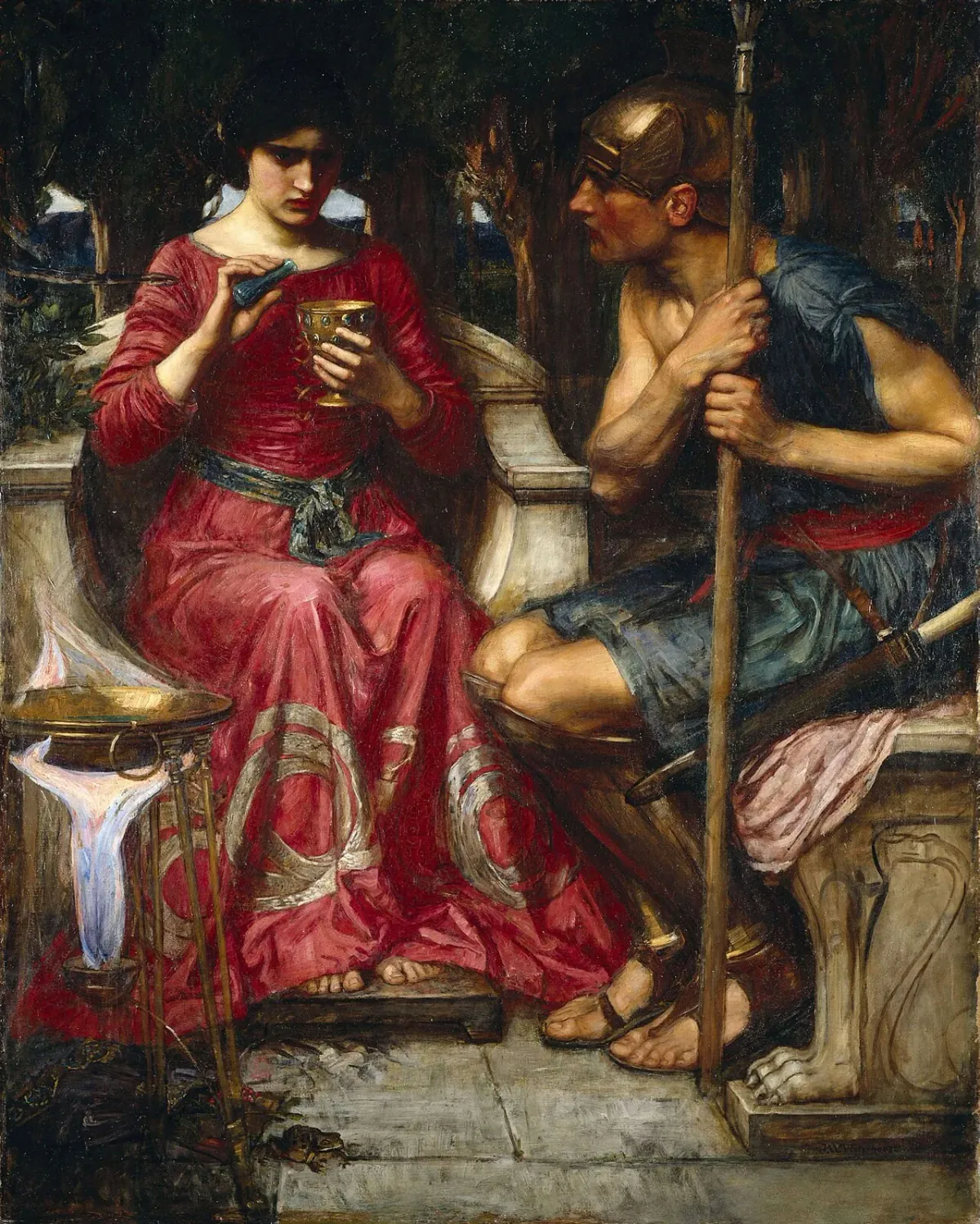
About the work
Euripides' tragedy „Medea" was first performed in 431 BC and won only third prize at the City Dionysia — but in the course of antiquity it became one of the most discussed plays of Greek theatre. The story of the barbarian princess who kills her own children has fascinated generations of adapters.
Plot
In Corinth, Medea lives with her husband Jason and two sons in exile. Jason owes her everything — she helped him win the Golden Fleece in Colchis, betrayed her father, murdered her brother, all for love. Now Jason intends to leave her and marry the daughter of the Corinthian king Creon. Creon banishes Medea from Corinth but grants her one day's delay. Medea uses that day for vengeance. She sends her rival a poisoned wedding gown and diadem, on which the princess and her father die in agony. Then Medea kills her own two children — to deprive Jason of his last bond. In the chariot of her grandfather Helios she flees skyward with the children's corpses, leaving Jason behind in despair.
Cultural significance
Medea is one of the most provocative works of world literature: a play about a woman's rights, the foreigner's honour, the politics of gender. The final flight in the divine chariot — Medea as a being above human justice — is one of the most contested moments in all theatre. Adaptations stretch from Seneca, Corneille and Grillparzer (1820) through Anouilh (1946) and Heiner Müller's Medeamaterial (1982) to Christa Wolf's Medea-Stimmen (1996).