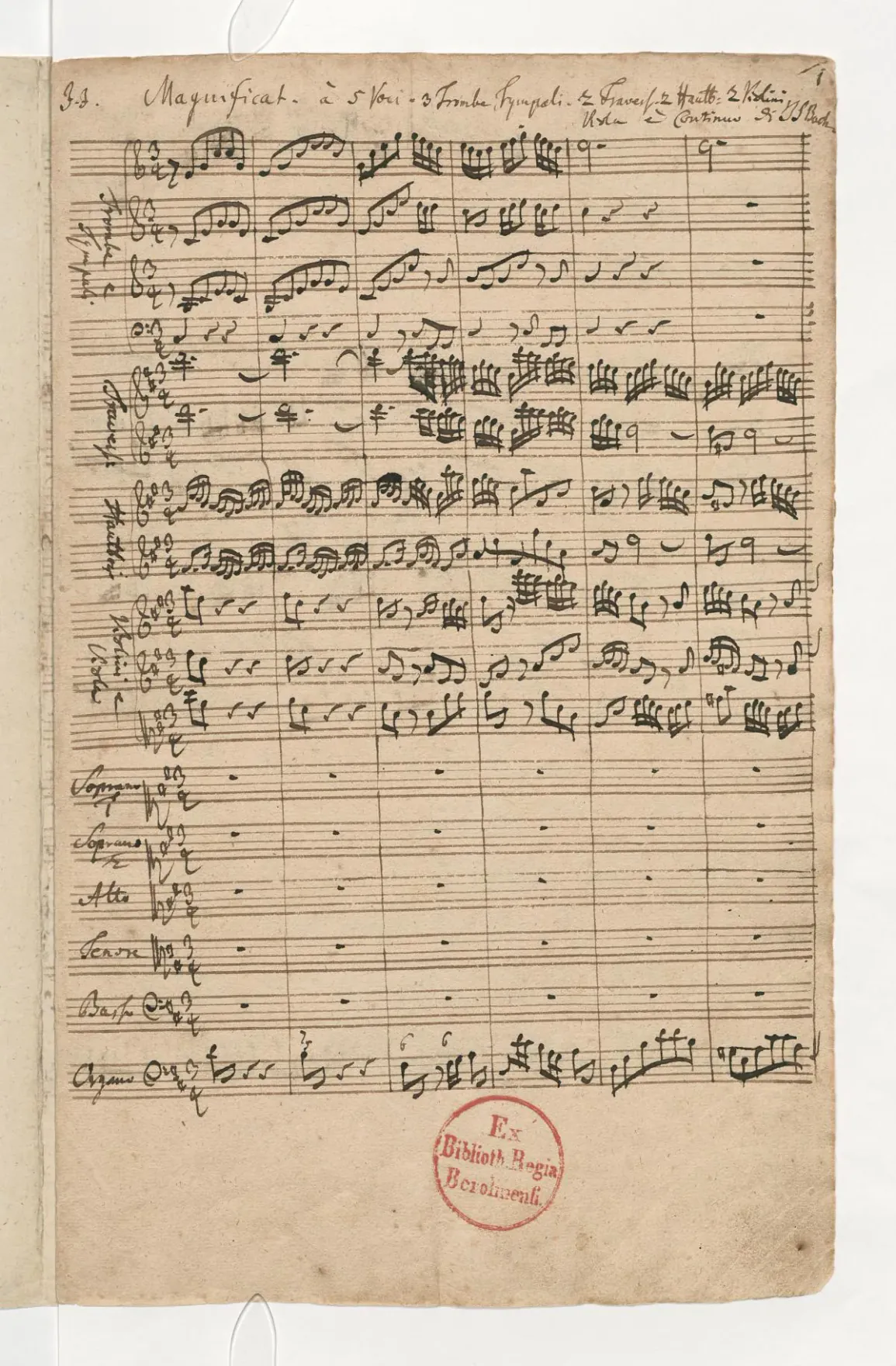
About the work
Johann Sebastian Bach's „Magnificat" (BWV 243) was composed in 1723 in Leipzig — among the first works of his tenure there as Thomas Cantor. An earlier version in E flat major, with interpolated Christmas movements, was performed on Christmas Day 1723; the later revised D major version (1733) is the standard version performed today.
Plot
The work sets in Latin the Song of Mary from Luke's Gospel 1, 46-55 — the Marian hymn that Mary speaks after the annunciation of the imminent birth of Christ. The setting comprises twelve movements in a compact half-hour form: the jubilant opening chorus „Magnificat anima mea Dominum", the soprano aria „Et exsultavit", the simple soprano solo „Quia respexit" with oboe d'amore, the chorus „Omnes generationes", the bass aria „Quia fecit mihi magna", the alto-tenor duet „Et misericordia", the chorus „Fecit potentiam", the tenor aria „Deposuit potentes", the alto aria „Esurientes" with two flutes, the trio „Suscepit Israel" with oboes and the cantus firmus „Tonus peregrinus", the double fugue „Sicut locutus est" and the closing doxology chorus „Gloria Patri" with a triumphant return of the opening material.
Cultural significance
Bach's Magnificat is one of the most popular Bach works and often appears on concert programmes, since it offers a complete Bach experience in only 30 minutes. It is Bach's only Latin Mass/hymn setting alongside the B Minor Mass. The jubilant opening is one of the most stirring openings in the Bach literature. Performances often take place in Advent or at Christmas, although this was not historically obligatory. Standard recordings under John Eliot Gardiner, Philippe Herreweghe, Masaaki Suzuki, Ton Koopman.