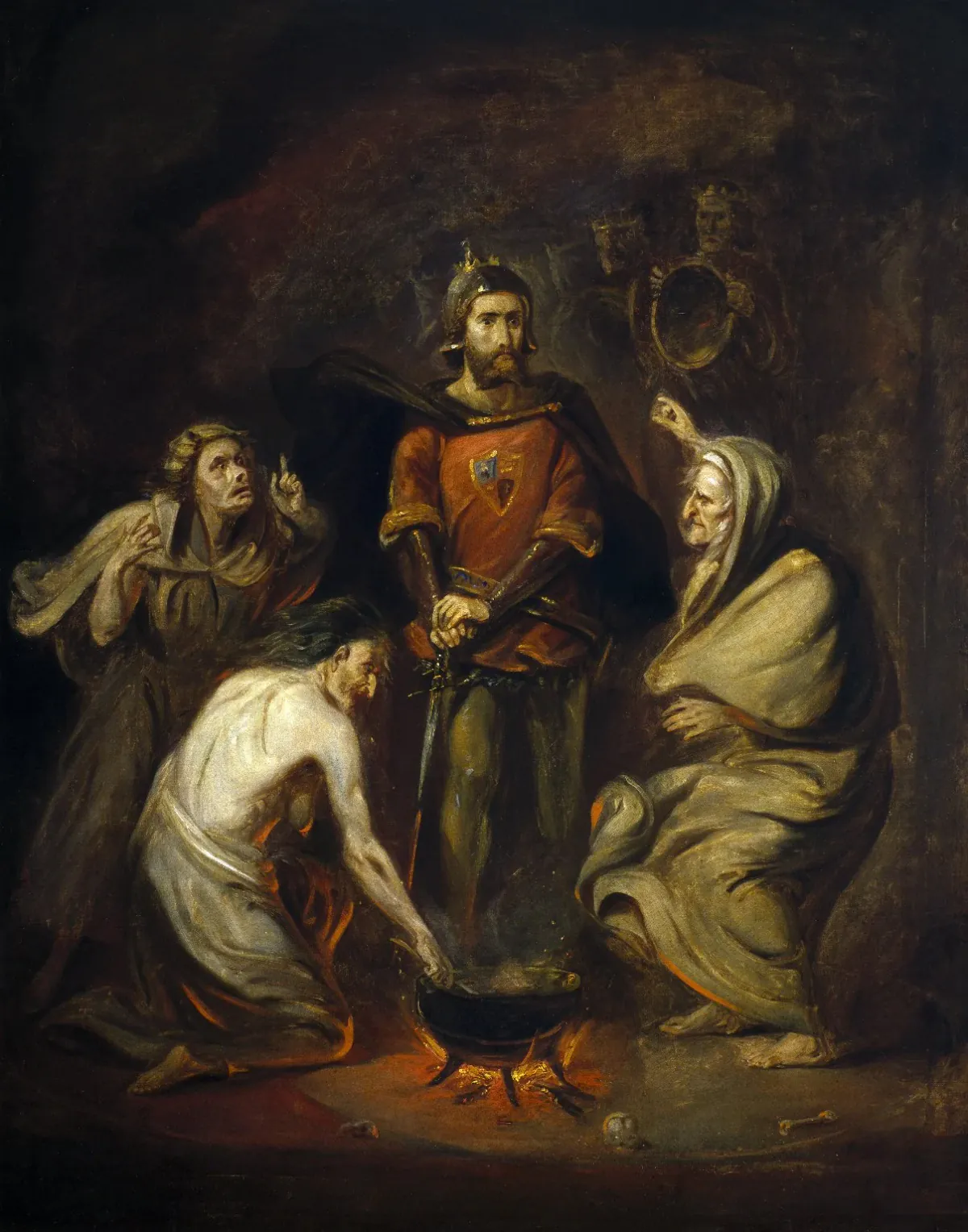
About the work
William Shakespeare's tragedy in five acts was probably written around 1606 and is his shortest and most concentrated major play. Based on episodes from Holinshed's Chronicles and traditionally believed to have been composed in honour of King James I, the play dramatises the corrupting power of ambition with unparalleled psychological intensity. A pervasive theatrical superstition holds the work to be cursed, with actors traditionally referring to it only as the Scottish play.
Plot
The Scottish nobleman Macbeth, returning from battle, encounters three witches who prophesy that he will become king. Encouraged by his ambitious wife, he murders King Duncan in his sleep and takes the throne. Wracked by guilt and paranoia, Macbeth orders the murder of his former comrade Banquo and the family of Macduff. Lady Macbeth descends into madness, sleepwalking and attempting to wash imagined blood from her hands before dying. The English army, led by Malcolm and Macduff, advances on the castle. Macbeth, still trusting the witches' riddling assurances of invincibility, is killed by Macduff in single combat.
Cultural significance
Macbeth is among Shakespeare's most frequently performed tragedies and has generated a uniquely rich operatic and cinematic afterlife. Giuseppe Verdi's opera of 1847 was his first engagement with Shakespeare; Roman Polanski's 1971 film, Akira Kurosawa's Throne of Blood, and Joel Coen's 2021 adaptation are landmark cinematic interpretations. The sleepwalking scene and the tomorrow, and tomorrow, and tomorrow soliloquy are cornerstones of the acting repertoire.