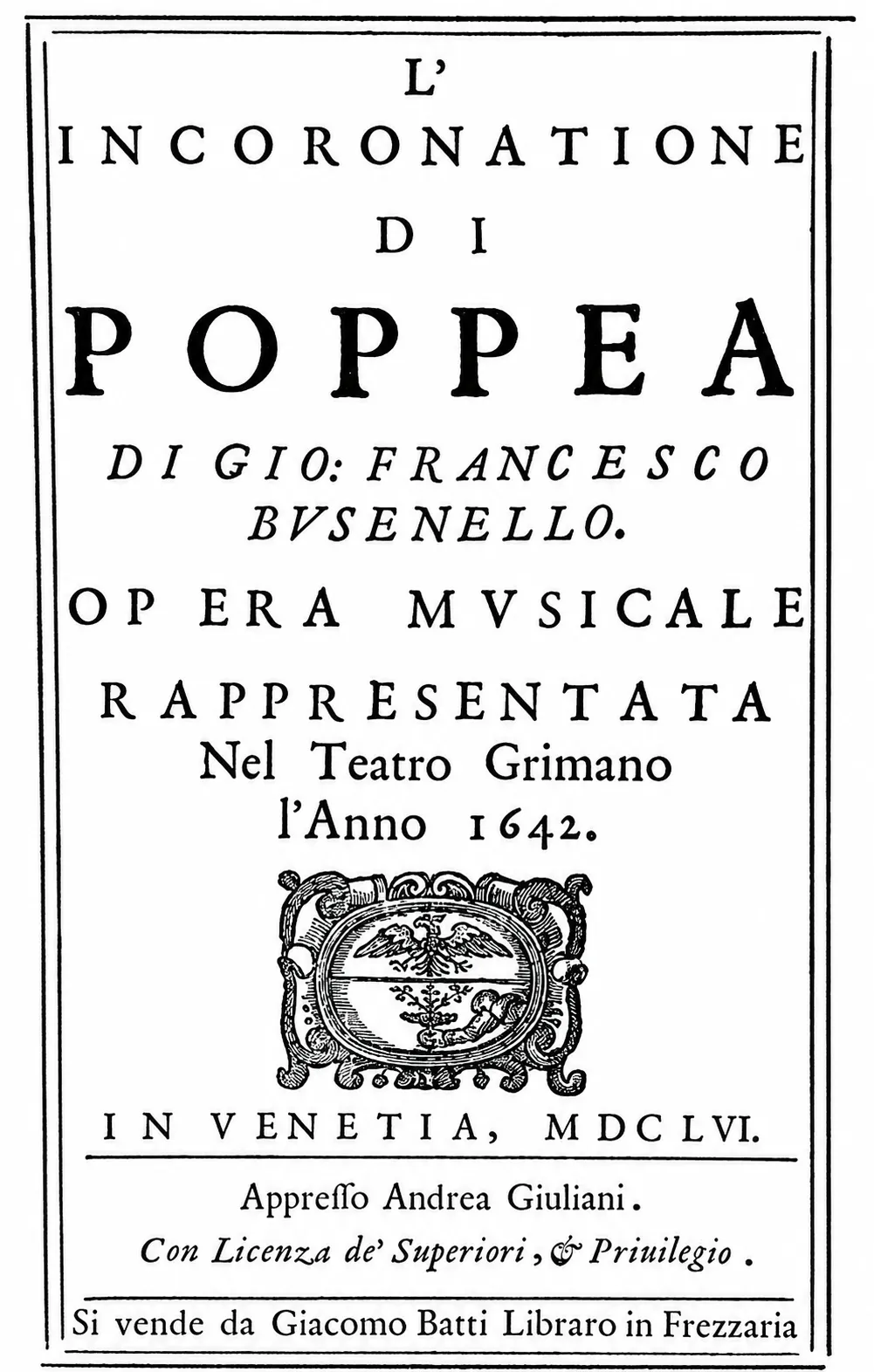
About the work
Claudio Monteverdi's „L'incoronazione di Poppea" was premiered in Venice in 1643 — Monteverdi's final opera, composed in his 76th year. Giovanni Francesco Busenello's libretto is the first opera in history to treat a historically documented subject (Tacitus's „Annals") — and at the same time the first in which the wicked triumph.
Plot
Rome under Emperor Nero, AD 65. In the prologue the allegories Fortune, Virtue and Love quarrel — Love boasts that she is mightier than virtue and fate. The action will prove it. Poppea, mistress of the senator Ottone, has bewitched Emperor Nerone. Ottone returns one morning to Poppea's house and finds two imperial soldiers on guard; he realises: she has become his. Poppea presses Nerone for marriage — obstacles: Seneca's philosophical warnings, the empress Ottavia, Ottone's despair. Nerone orders Seneca's death; Seneca calmly opens his veins in the bath. Ottavia commands Ottone under threat of death to murder Poppea. Ottone, disguised as Drusilla (who loves him), creeps to the bed, but Love protects Poppea. Ottone and Drusilla are caught — Nerone banishes both, and Ottavia. The closing scene: Poppea's coronation as empress and her famous love duet with Nerone — „Pur ti miro, pur ti godo" — one of the most beautiful love duets in operatic history.
Cultural significance
L'incoronazione di Poppea is the most important opera of the early Baroque and a key moment in operatic history. The final duet „Pur ti miro" is possibly not by Monteverdi himself but by one of his pupils (Cavalli or Sacrati) — the authenticity question is one of musicology's great open questions. Recordings under Nikolaus Harnoncourt (1974), René Jacobs and William Christie are reference performances. Productions by David Alden, Robert Wilson and Krzysztof Warlikowski have firmly established the work in the modern repertoire.