About the work
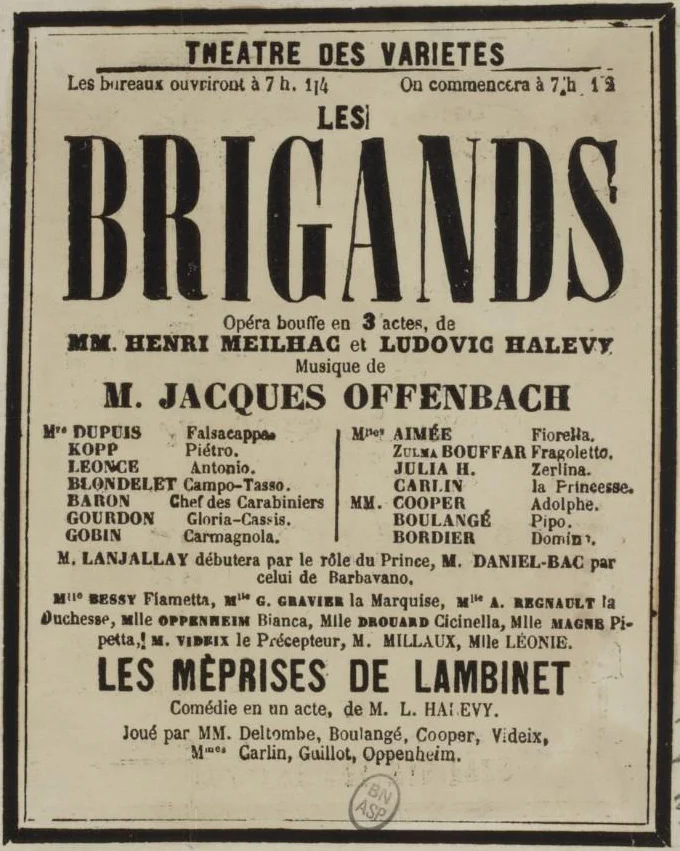
Die Banditen (French: Les Brigands) is an opéra-bouffe in three acts by Jacques Offenbach, to a libretto by Henri Meilhac and Ludovic Halévy. It was first performed on 10 December 1869 at the Théâtre des Variétés in Paris. In this satirical work Offenbach pushes his mockery of politics, finance and authority to its limit: bandits, corrupt courtiers and bumbling gendarmes are barely distinguishable, and the real thieves often sit in government offices. With sparkling melody and biting wit, "Les Brigands" is among Offenbach's most ingenious operettas.
Plot
Falsacappa's band of robbers lives by ambush, but business is poor. When Falsacappa's daughter Fiorella falls in love with a young man, the private intrigue becomes entangled with a larger one: the bandits set out to intercept a princess's dowry being negotiated between two courts. In ever-new disguises — as beggars, as a diplomatic mission, as innkeepers — they infiltrate court and soldiery. In the end it turns out that the treasury has long since been plundered by the "respectable" authorities, and the bandits get away with an ironic wink.
Cultural significance
"Les Brigands" is one of Offenbach's sharpest social satires, taking aim at officialdom and bureaucracy with its famous refrain about the gendarmes who always arrive "too late". The work influenced the tradition of comic opera and musical satire far beyond France. After a chequered reception, "Les Brigands" is again performed with pleasure today, because its mockery of corruption and double standards has lost none of its relevance.