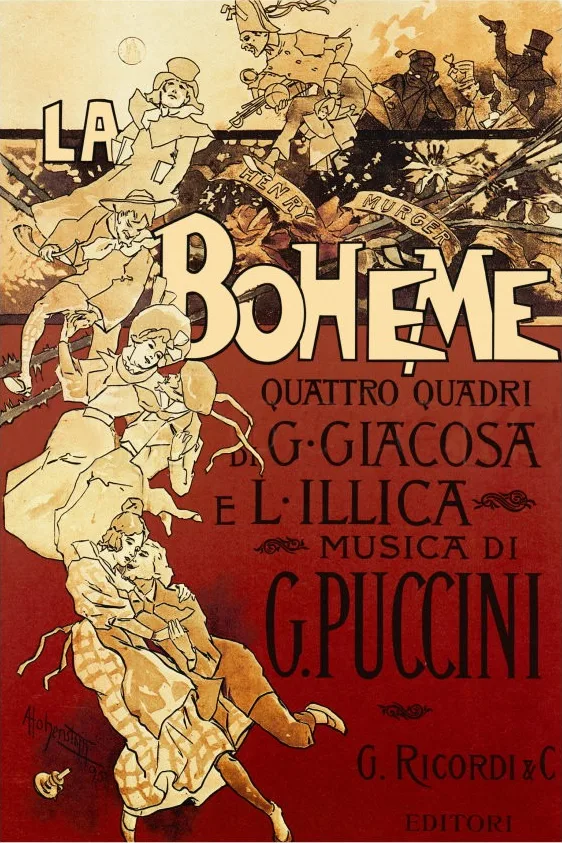
About the work
Giacomo Puccini's opera in four scenes was premiered in Turin in 1896 under Arturo Toscanini. The libretto by Luigi Illica and Giuseppe Giacosa is based on Henry Murger's novel „Scènes de la vie de bohème" (1851) and created the iconic portrait of young Parisian artists in the nineteenth-century garret.
Plot
In an unheated Paris garret on Christmas Eve 1830, the four bohemians are freezing: the poet Rodolfo, the painter Marcello, the philosopher Colline, the musician Schaunard. The sickly seamstress Mimì knocks at the door, her candle blown out. Rodolfo falls in love at first sight — aria „Che gelida manina". The four go with Mimì to the Café Momus, where Marcello's former lover Musetta appears. Three months later: Mimì confesses to Marcello that Rodolfo's jealousy is tormenting her. Rodolfo reveals to Marcello the true reason for his withdrawal — Mimì is slowly dying of consumption and he has no means to help her. Mimì overhears, and a moving farewell quartet follows. The final act, in the garret: Rodolfo and Marcello, both alone, remember the lost love. Musetta brings the dying Mimì back. In a moving final scene Mimì dies in the arms of her friends, while Rodolfo cries her name in despair.
Cultural significance
La Bohème is Puccini's most-performed opera and one of the most popular operas worldwide. Mimì's „Sì, mi chiamano Mimì", Rodolfo's „Che gelida manina" and Musetta's waltz „Quando me'n vo" belong to the world's musical heritage. The work inspired the musical „Rent" (1996) and countless productions — from Franco Zeffirelli's postcard-Milanese La Bohème (1963) to Jonathan Miller's Edinburgh staging. Robert Dornhelm's 2008 film version is outstanding.