About the work
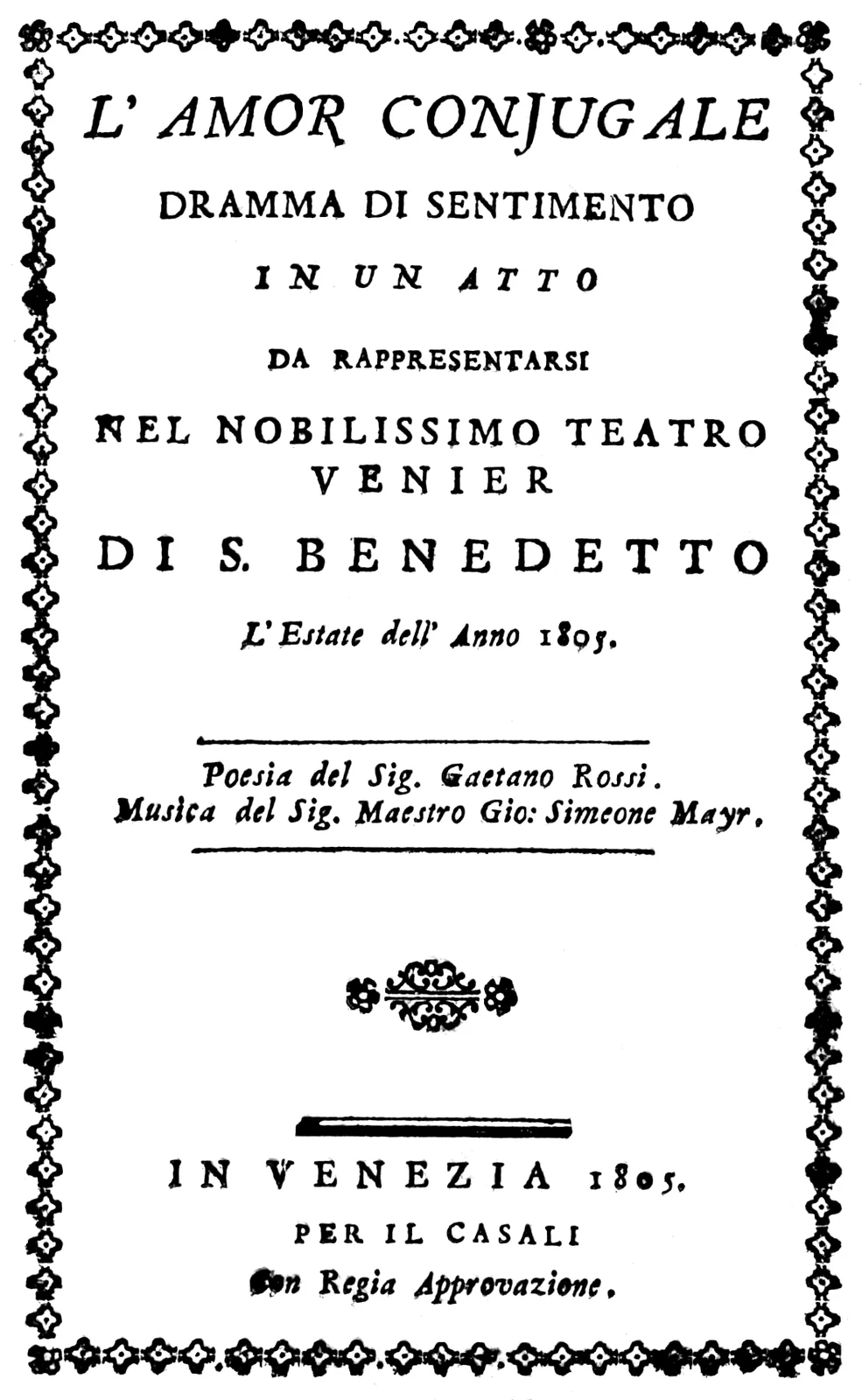
L'amor coniugale is a one-act farsa sentimentale by Johann Simon Mayr to a libretto by Gaetano Rossi, who condensed Jean-Nicolas Bouilly's French libretto for Pierre Gaveaux's opera Léonore, ou L'amour conjugal (1798) into nineteen scenes and moved the action from the Napoleonic Wars to 17th-century Poland. It premiered on 26 July 1805 at the Teatro Nuovo in Padua.
Plot
Disguised, Zeliska gains access to the prison where her husband Amorveno is being held unjustly, in order to secure his release. Unlike the politically charged Fidelio material, which Beethoven drew from the same source, Mayr's version emphasises the personal relationships between the characters and mixes in comic elements.
Cultural significance
After its premiere, L'amor coniugale was performed with success across Europe for decades. The score combines the orchestral tradition of Mozart and Haydn with the multi-voiced ensembles of bel canto, marking Mayr as one of the pioneers of that style.