About the work
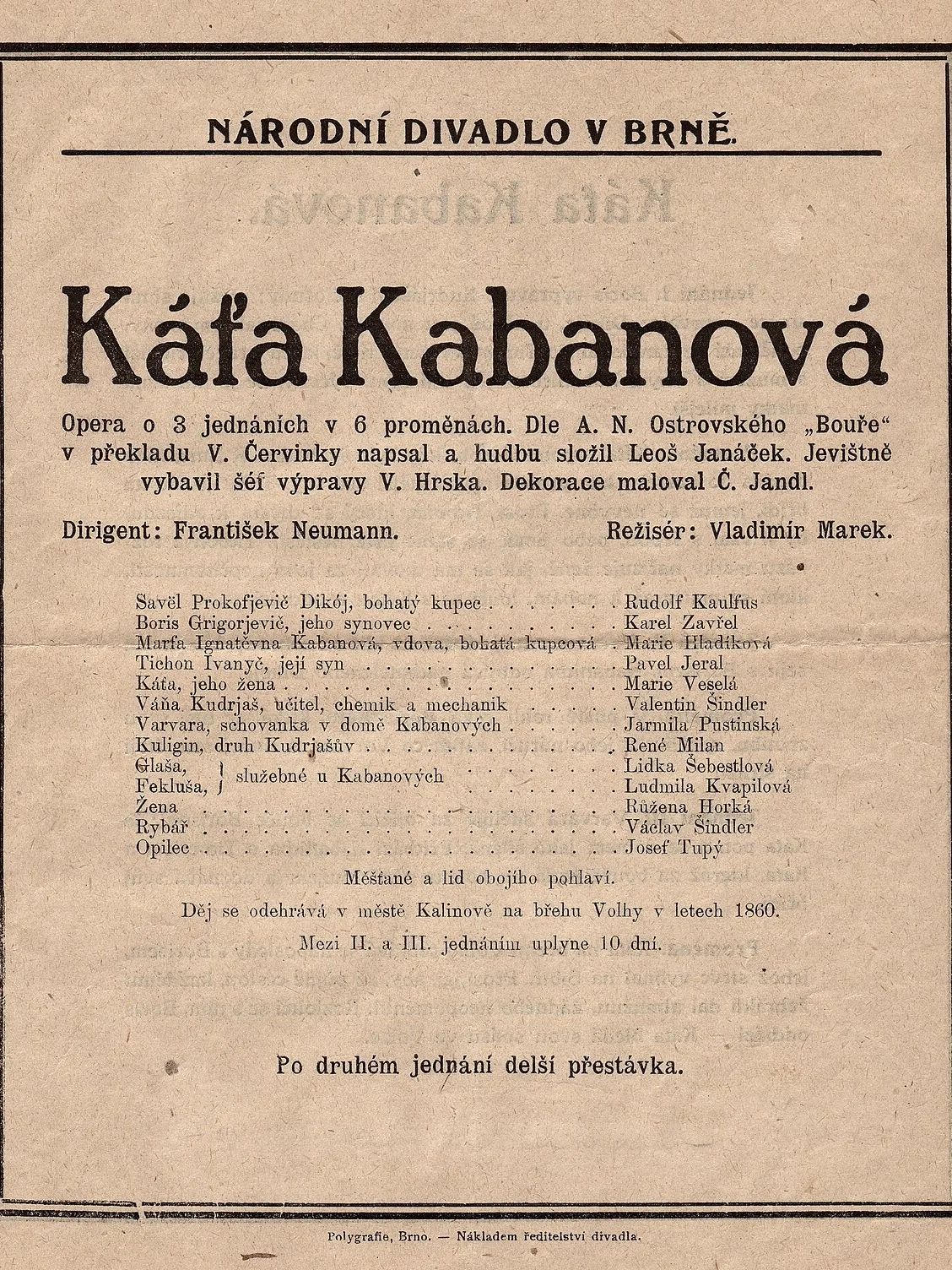
Leoš Janáček's three-act opera was premiered in Brno in 1921 and is based on Alexander Ostrovsky's play „The Storm" (1859). The story of a Russian merchant's wife who collapses under her mother-in-law's tyranny is one of opera's most psychologically penetrating portraits of a woman.
Plot
In a small Volga town the young Káťa lives with her weak husband Tichon and his domineering mother Kabanicha, who constantly humiliates her. While Tichon is away on business, Káťa wrestles with her longing for love — she falls for Boris, the nephew of a wealthy merchant. Her friend Varvara arranges nightly garden meetings. During a thunderstorm Tichon returns; in the church Káťa's conscience breaks and she publicly confesses the adultery. Boris is sent to Siberia by his uncle's order. Káťa and Boris share a last desperate farewell. Left alone, Káťa throws herself into the Volga.
Cultural significance
Káťa Kabanová is, after „Jenůfa", Janáček's second great portrait of a woman and is regarded as his most emotionally concentrated opera. The fusion of speech melody (Janáček's theory of „speech motives") with brief orchestral upheavals — especially the storm and Volga sonorities — set new standards in operatic composition. The title role ranks among the great lyric-dramatic soprano parts of the twentieth century; stagings from David Alden to Christof Loy have firmly established the opera in the repertoire.